
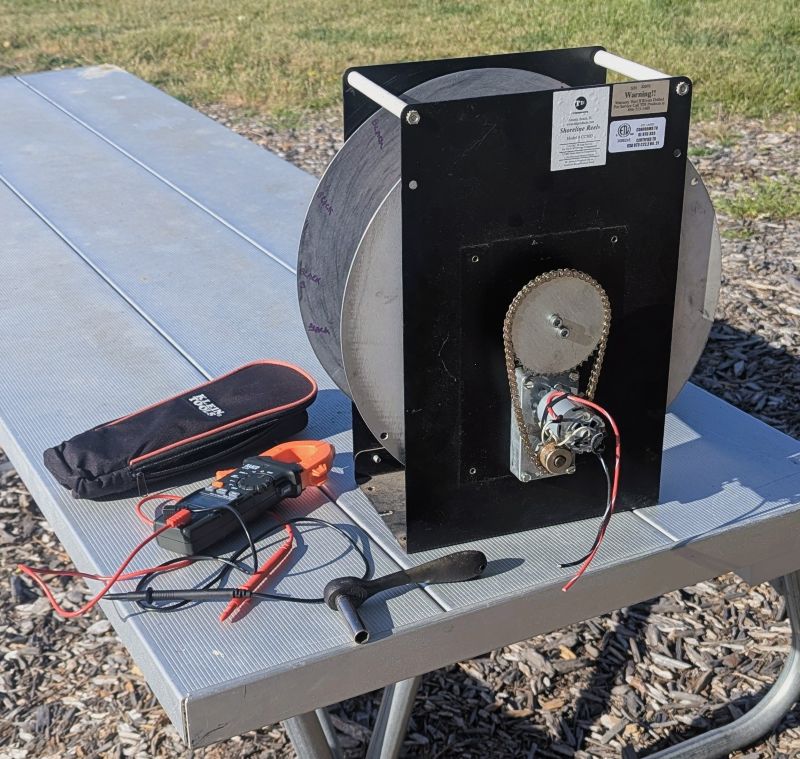
Fixing our RV power problem(s) this summer has become a theme on this blog. Parts can break over time when things don’t go right. This time, I have been carrying around a new cord reel since June, and I didn’t have enough time to fix the power problem until we were camping in the Bitterroot Mountains in Montana in July. If you can camp without outside electricity, it’s easier to work on a power problem that involves using outside power.
Most of the photos of my disassembled RV cord reel were taken after I removed it in May after it failed. I didn’t order a new cord reel until I completely understood that my cord reel couldn’t be repaired because Southwire doesn’t sell parts; they sell assembled cord reels. I didn’t know that when I ordered it, but the new cord reels aren’t as good as my 2008 version. My cord reel lasted nearly twenty years before it failed.
I know the damage was a little here and there spanning multiple years, but I didn’t know how it was treated before I owned it. I think much of the damage happened at Pinnacles National Park in May. Here is a link to that story. Crappy 30-amp power

In this case, our RV power problem started when the RV was first manufactured, and I feel pretty fortunate I got almost 20 years of use before I needed to make this repair. I also made a simple fix that will make it unlikely (or at least less likely) that we will ever have this problem again. I will tell you about the fix near the end of the article. In this RV power problem, we burned out the contactors inside our power cord reel, causing dead spots when rotating the reel.
Again, we had a small electrical fire.
“Electrical fire” is an overstatement. What was missing from our “fire” was fuel. We had arcing (a combustion source) and oxygen, but a fire requires fuel. Our RV power problem included electrical arcing that ate away at the internal parts of our power cord reel, destroying the components until it stopped working. Parts are not available; otherwise, this blog post would be about repairing our cord reel.
The difference between our RV and lower-priced models
I have discussed the differences between our RV and some of the lower-priced models in the Tiffin line-up before. One difference is the use of a power electric cord reel. This cord reel caused our power problem. Wouldn’t it be nice not to have to fight with your power cord when you’re plugging it in at a campground? And how about putting it away? An electric reel that would retract the cord at the push of a button would be great. So Tiffin included an electric power cord reel in our RV to make plugging in easier. Lower-priced Tiffin RVs didn’t get power cord reels.
Working our way north through the Bitterroot Valley
The Bitterroot Valley, south of Missoula, Montana, is one of my go-to places to relax. This isn’t our first visit. We’ve camped in the Bitterroot Valley before. This time, because of our power problems, relaxing wasn’t part of the plan. We camped after getting our generator repaired while traveling northbound through Idaho. Here are some links to articles about our previous visits to the Bitterroot Mountains.
- Camping in the Bitterroot Valley
- Going the old way across the Bitterroot Mountains
- The Lochsa River is wild and remote
Links to other power problems we had this year
Our RV power cord reel was cheaply made
Our RV power cord reel caused our power problem because it was cheaply made. The cord reel was engineered to wear out prematurely. I’m not the only person who had problems with this cord reel. Since then, I have heard stories about dozens of cord reels that wore out prematurely, and now I know exactly why. The design was cheaply made, and the manufacturer knew it. The contactor points are way too small. The manufacturer doesn’t even list the cord reel on their website.

Tiffin also installed our power cord reel in the wrong place in our RV. Our cord reel was located in the middle of our RV, in front of the rear tires and in front of the wet bay and storage tanks. Then it connected to the automatic transfer switch behind the wheels.
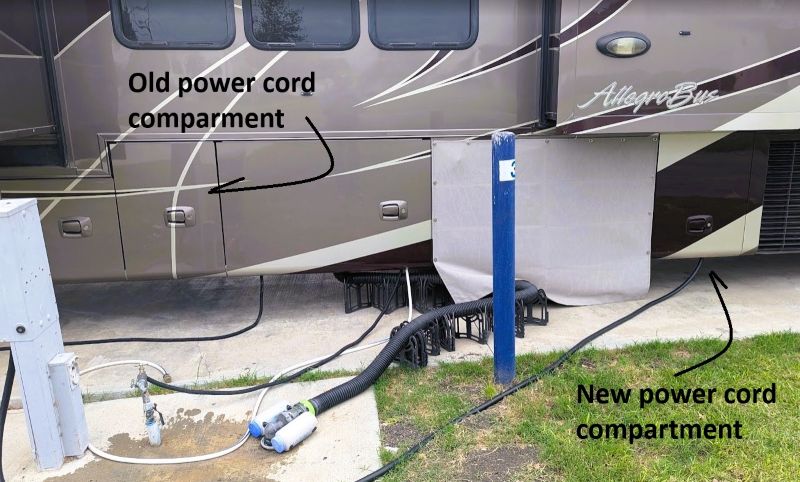
I have complained multiple times about how our RV was wired. Here is a general layout of where the electricity goes in our RV. Power enters the RV through the power cord at the center of the RV on the driver’s side. It then connects to the transfer switch in the back compartment on the driver’s side.
From the transfer switch, the power goes to the circuit breaker panel in the far back on the passenger side, inside the closet. From there, it goes back to the inverter/converter located at the center of the RV on the driver’s side. From there, it routes power back to the circuit breaker panel for AC power and to the house batteries for DC power, both located in the passenger-side back corner.
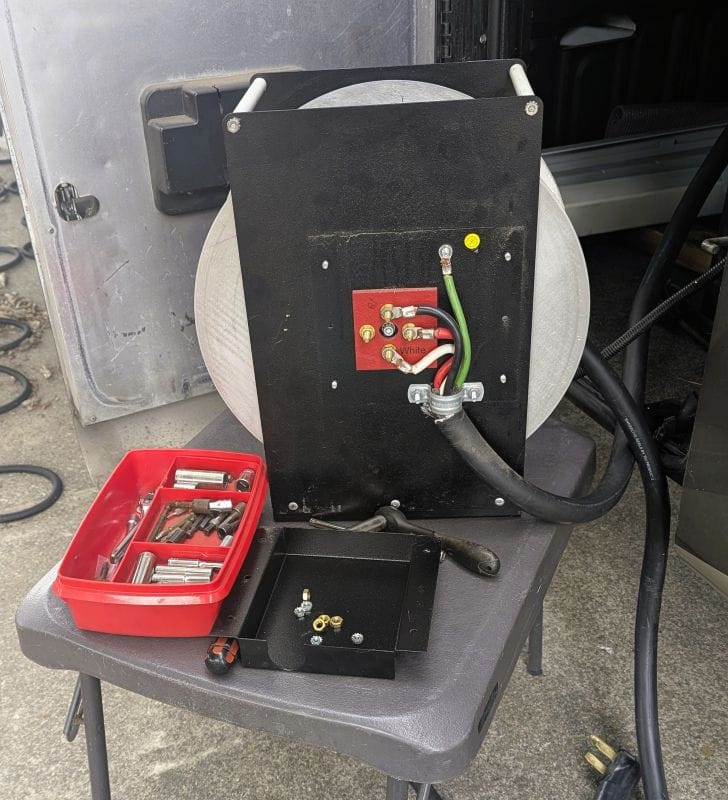
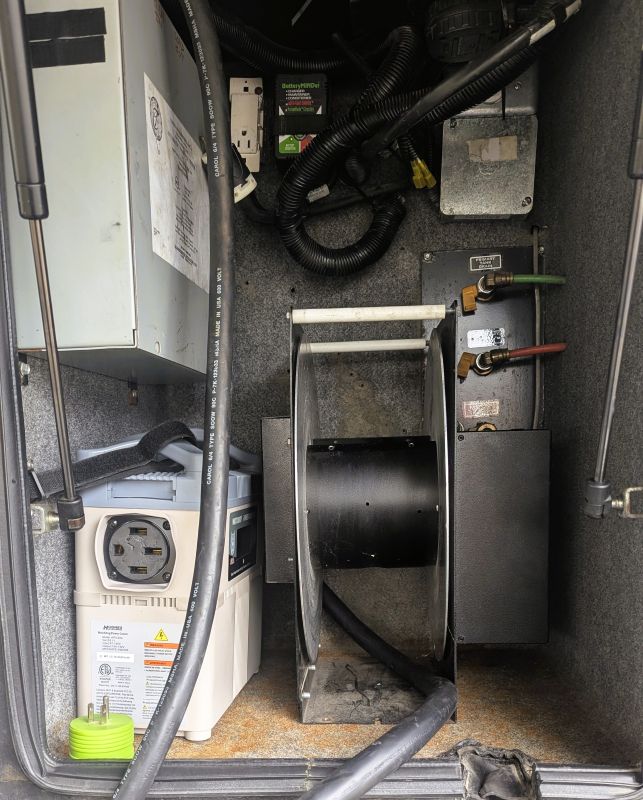
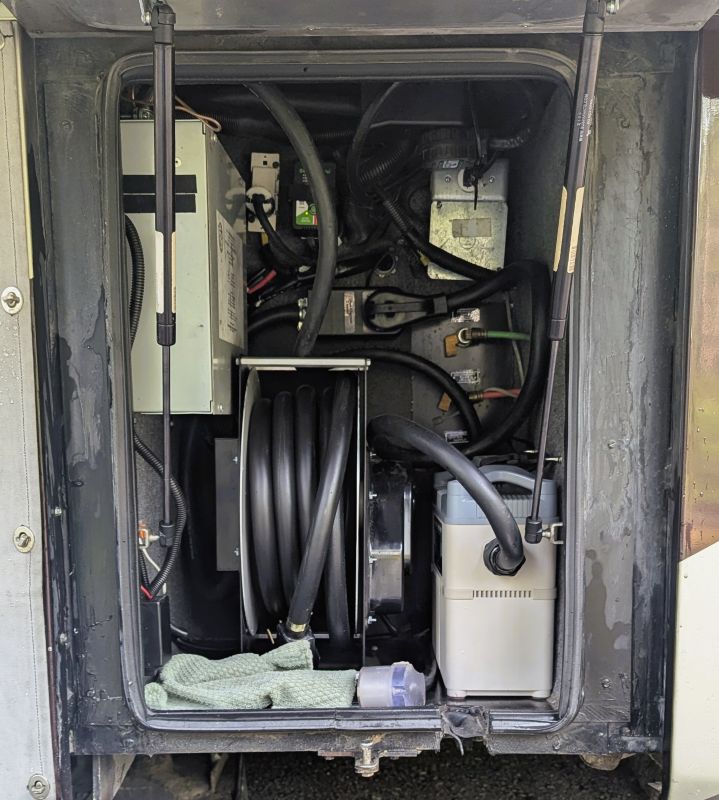
Years ago, I moved the house batteries to the compartment next to the inverter/converter. Now I finally moved the power cord reel next to the transfer switch. The incorrect location wasn’t the source of our RV power problem.
Tiffin could have placed the cord reel one foot away from the transfer switch instead of 12 feet in front of it. Because you can’t go through the rear wheel or through the holding tanks, you need to add an additional 6 feet of cable to make the routing work. Altogether, we have more than 18 feet of huge 50-amp wire that we didn’t need.
Even though I moved the cord reel to right next to the transfer switch, I still have the huge cable in the RV because removing it would have been very difficult. Some people have heartburn about me doing things that Tiffin designed. It doesn’t bother me, and they don’t live with it — I do. I can’t fix every design problem, but this one was easy enough to fix when my power problem came up.
How to test your power cord reel without taking it apart.
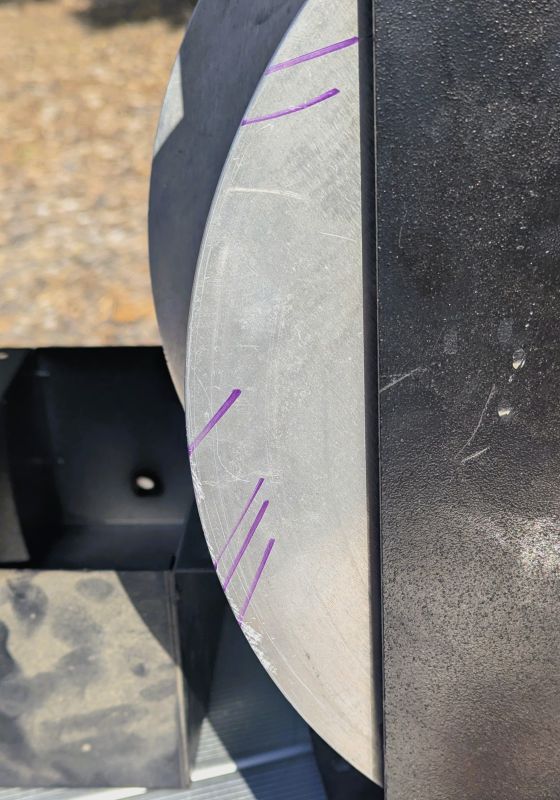
The test is simple. After removing your cord reel from the RV, use an ohmmeter to connect the input plug at the end of your cord reel to the same color wire on the output cord on the other side. This should be at zero ohms (no resistance). Zero ohms means the circuit is solid from one end through the cord reel to the output. Then, while reading the ohms, slowly rotate the reel for a full revolution. Each time the ohmmeter jumps from zero ohms to open circuit, you have a dead spot at that point in the rotation.
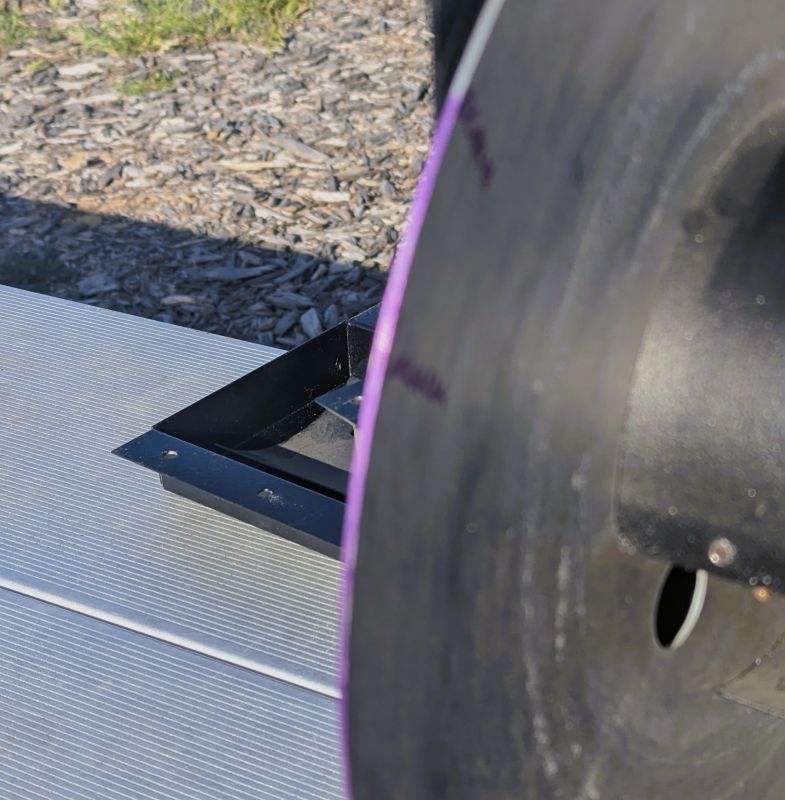
Repeat the test for each wire (red, black, and white). If you have one dead spot, you could try to avoid it stopping the rotation where the connection was solid. For me, on the black wire, I had more dead sections than good sections. Our power problem on the black wire made the cord reel unusable.
The source of our RV power problem
The source of our RV power problem was that the power cord reel was designed to fail. I knew the location Tiffin installed it was incorrect when I purchased the RV. I also knew cord reels had a poor reputation, which many people blame on RV owners, not the poorly designed product. I also thought it was a problem created by incorrect use until my power cord reel failed. Now I have changed my mind. The power cord reel was engineered with a limited life expectancy. The engineers knew, or should have known, the contactors wouldn’t last long. The contactors simply were not big enough.
Don’t ever move it
If you have a power cord reel, the one thing you should never do is move it while it is plugged in. Moving it with power applied makes the contactor move along the slip ring, causing arcing and damaging the contactors. It also damages the slip ring. Again, at the end of this article I will show you what I do so I cannot move my cord reel when it is plugged in, and if you’re lucky, you will not ever have this power problem.
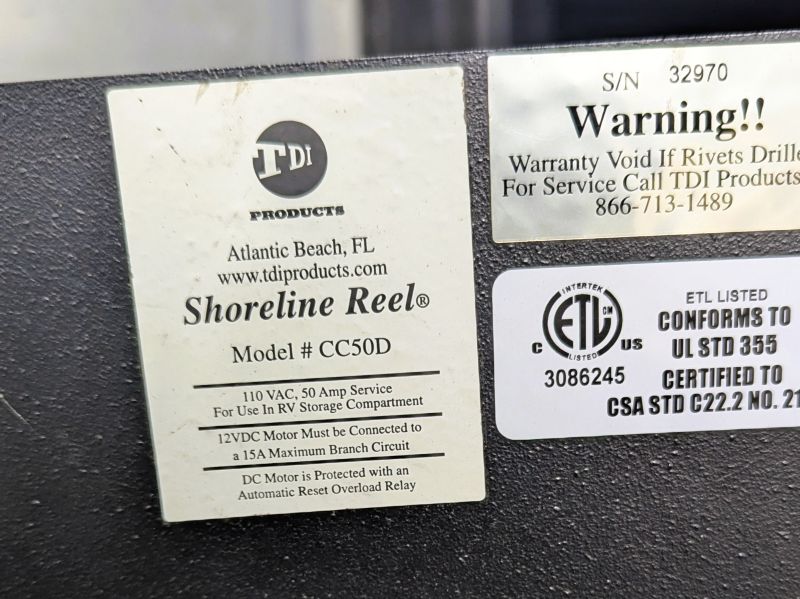
I knew moving the cord reel while energized would damage the contactors, so I never moved my power cord reel while it was plugged into the campground pedestal. My RV power problem was not caused by me moving the reel after it was plugged in. I can’t say what happened before I owned my RV, but I never moved it, so I never dragged the connectors across the slip ring. I had no problems for six years during my ownership, then it failed right after our visit to Pinnacles National Park.
No drilling
Using a drill during a repair voids the warranty. My warranty had aged out years before it failed. Using a drill voids the warranty because Shoreline didn’t want you to repair the reel and preferred to sell you a new one. Now Shoreline is gone; perhaps they should have made better decisions about making better products. They knew that to repair it, you would have to drill out the rivets holding the contactors against the slip ring. Once you used a drill, you would see the contactors were damaged and then try to buy parts. You would also know your RV power problem was due to the cheap design.
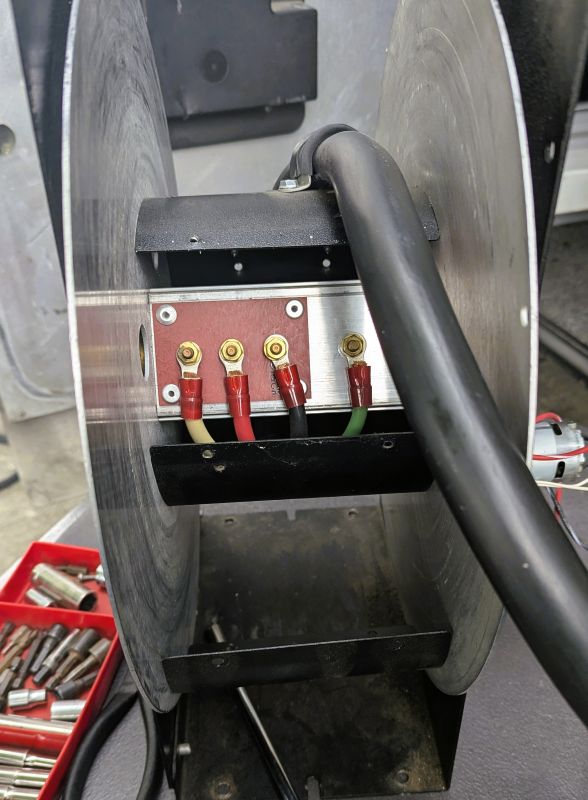
Rumor had it that a fellow in Colorado was making a replacement contactor set for people like me who would rather repair than replace. For some unknown reason, he quit selling it. It sounds specious to me.
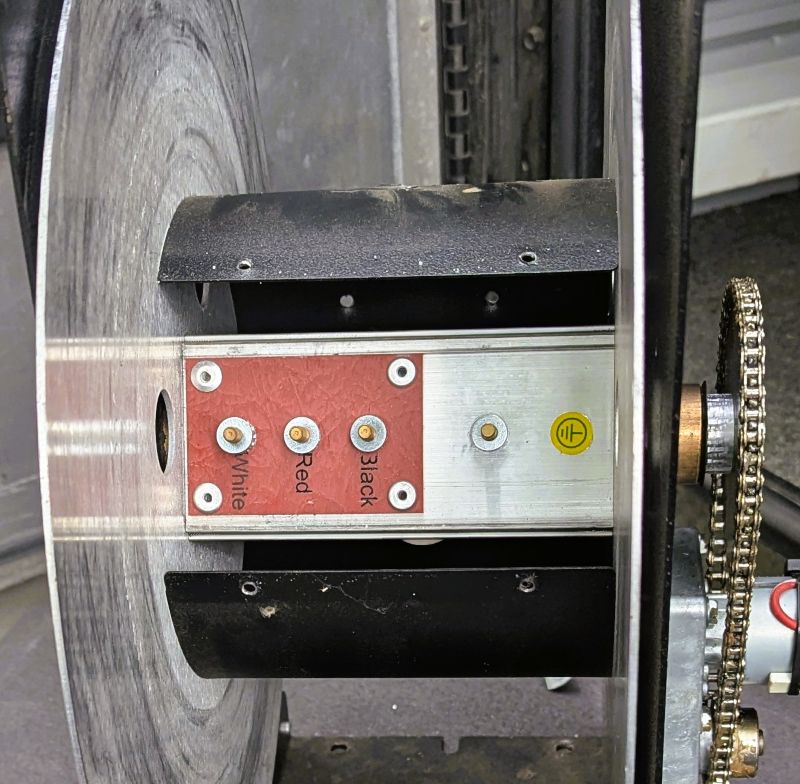
My old warranty was worthless; the company was gone. My new warranty is worthless too. Even if you ship the non-functioning power cord back to the manufacturer, they’ll say you damaged it and that the damage voids the warranty. Save the shipping cost and either go old school (without a cord reel) or replace the reel. I haven’t seen anyone get a replacement or even a free repair from the manufacturer under warranty. It wouldn’t take much extra money to make these contactors better than the original ones. Then your contactors wouldn’t arc or damage the slip ring.
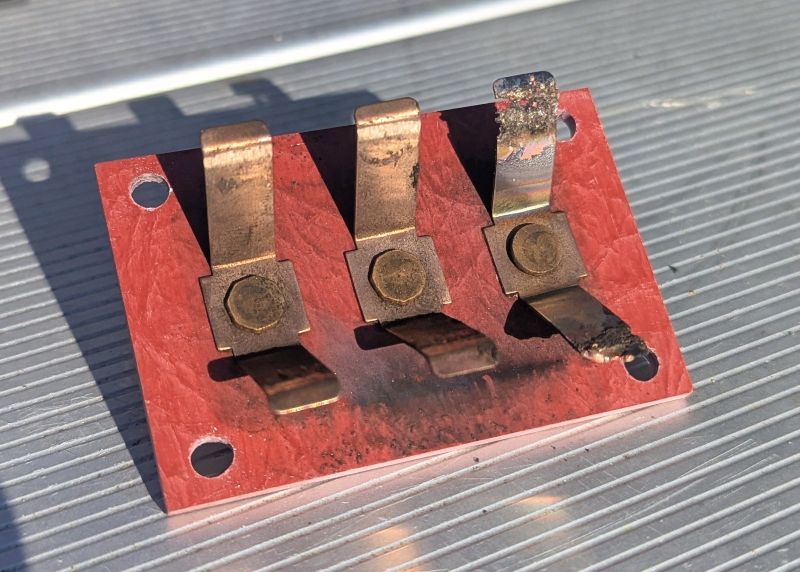
I went old school for a while
For a while, I went old school to bridge the gap between my RV power problem and installing my new cord reel. To me, old school meant using my backup 50-amp electrical cord as my primary power cord without using my broken cord reel. This meant that when I plugged in, instead of using my power cord reel, I plugged my extension cord into a receptacle mounted next to my transfer switch.
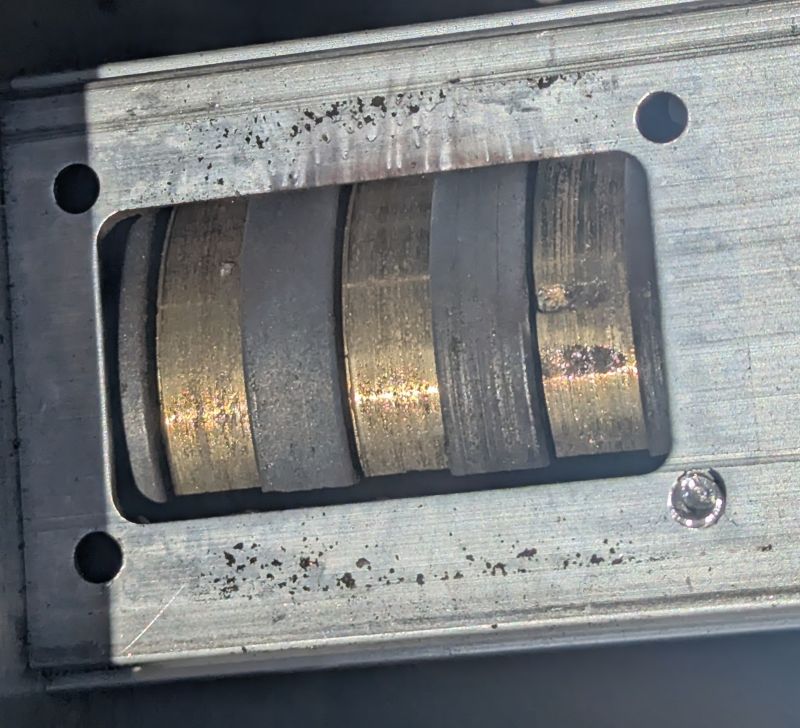
Corrosion is a huge problem
I believe that, besides cheaply designed contactors, corrosion on the contactor/slip ring contributed to my RV power problem. The cord reel has no corrosion protection and is essentially open to the weather. I can’t explain why nearly all my damage was on the black wire. I have included a few photos of the contactors with damage on the red wire.
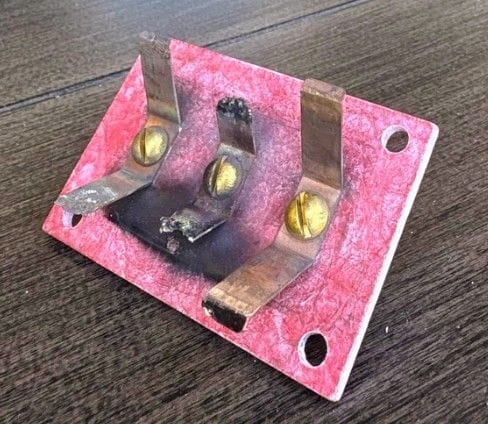
My problem was on the black contactor
My RV power problem destroyed the black-wire contactor, and I had heavy pitting on the slip ring, indicating the black wire was arcing at the contact point. The black contactor was destroyed, and I didn’t think I could shine up the slip ring enough to make a safe connection, and I couldn’t find a new slip ring or contactor to buy.
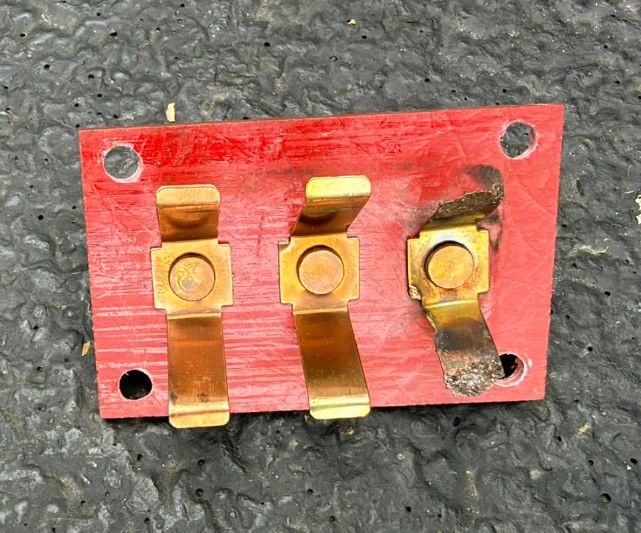
My new cord won’t move when plugged into a pedestal
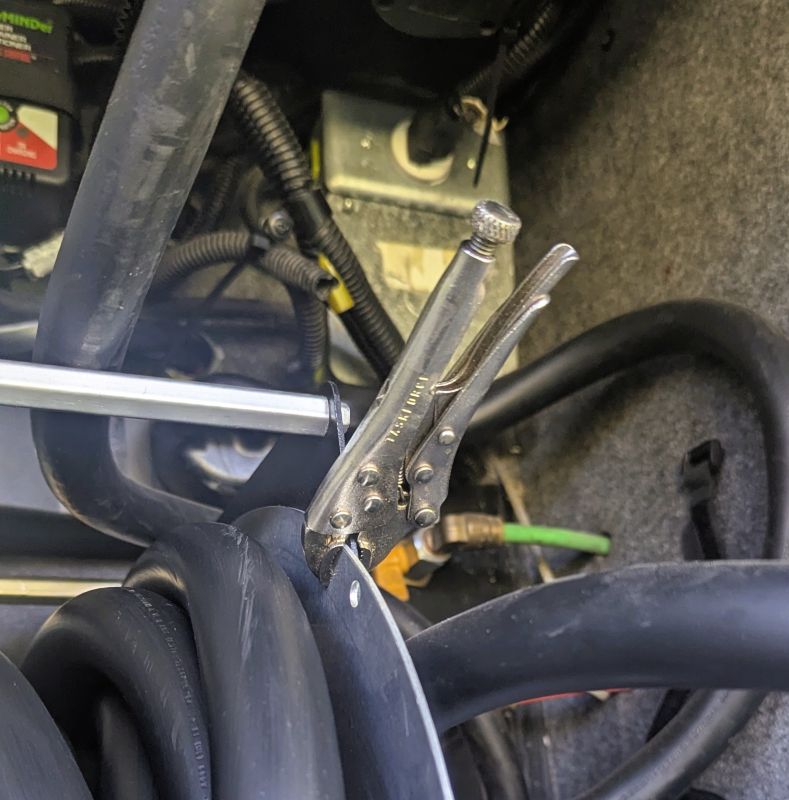
Using a small vice grip, I have eliminated all movement on my cord reel. This means that I can’t move my cord reel when the vice grip is squeezing the reel to the frame. I only started using this preventive measure on my new cord reel. Maybe it will help.
My old cord was higher quality compared to my new cord.
I like the flexibility of my old power cord reel much more than this newer, stiffer power cord. It was much easier to roll up on the reel than my new cord. Maybe someday, if I get bored and run out of things to repair (fat chance, this is an RV), then I will put the old flexible cord on my new cord reel. I also like the motor retraction on my old cord reel better. The new one has a clutch that engages before you can reel the cord up. The old one didn’t have a clutch.
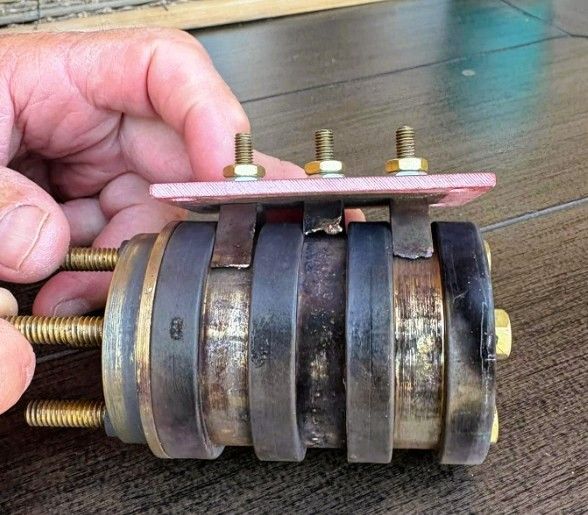
Shoreline Reel
TDI Products in Atlantic Beach, Florida, made my power cord reel. The company is closed, and Southwire (a huge electrical components company) made my new power cord reel and then distributed it as a Southwire RH54331RMK Shoreline Reel. Southwire doesn’t list the product on its website. Perhaps because it has such a history of problems. Retail prices usually run from $800-$1400. I got my replacement cord reel from Southeast Sales in Red Bay, Alabama; they beat every price I could find. Call them for the current price.
Please subscribe and join us on our journey.
We will add you to our email list and send you updates about new articles. Here is a link. Subscribe
About our links
As you know, our blog earns no income, which lets us stay independent and tell the truth. We don’t earn income or commissions. No, we don’t make paid endorsements. We don’t make recommendations; instead, we will tell you what we like (or dislike). We provide the links only as a quick reference to help our readers.
Links
About comments
We love seeing your comments, but please note they aren’t automatically posted. I get about 20 spam comments every day, so I have to turn off automatic comments. I read and then personally publish every comment to protect the blog, keep it on topic, and maintain its authenticity. You will not see your comment right after you hit submit. Sorry for the delay in publishing your comments. Some comments come from personal emails and Facebook. Please know that we would love to hear from you.
Glad this was fixable! And what a place to work on a project! I enjoy my projects when we are in beautiful places, although mine are mostly polishing and cleaning. Best to you both from the Dawghaus!
What a pain, but good job!
I’m really happy you can figure out all that goes wrong. We just had to depend on service techs who usually had no idea what they were doing. Safe travels.