
Our boondocking adventure in the Sawtooth Mountains started with a short stay at the North Fork Campground, a Forest Service Campground, a few miles north of Ketchum. What I didn’t know about staying at the North Fork Campground was that winter would start at the end of June.
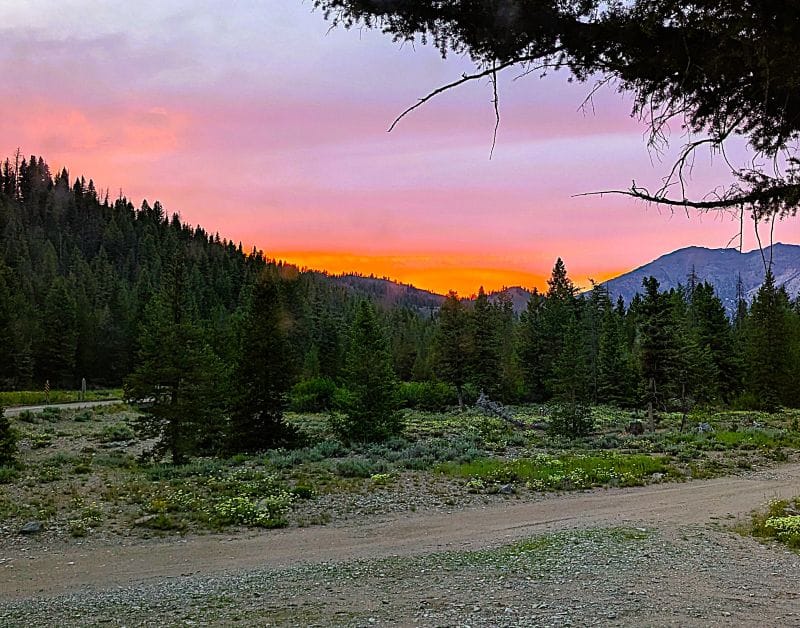
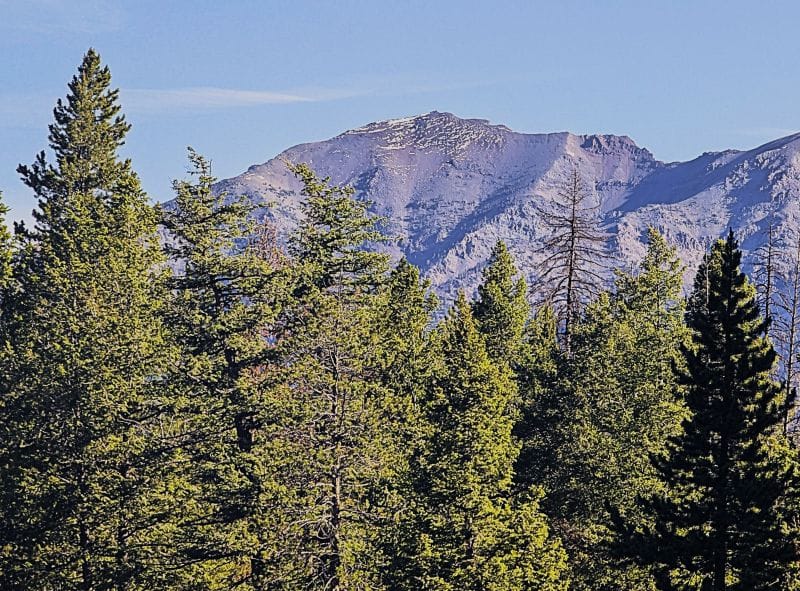
The photo at the top is after sunset, taken from our boondocking spot in the Sawtooth Mountains north of Ketchum.
The purpose of our stay at the North Fork Campground, located just south of the Sawtooth National Recreation Area Visitor Center, was to find a boondocking spot near Ketchum (Sun Valley Ski Resort) where we could spend at least a week before traveling further north toward Stanley. When I planned our trip last winter, I had no idea that winter would start at the end of June with plenty of rain and the real possibility of snow. I needed a little time to find a great boondocking site for our week-long stay.
Finding a boondocking site
Unless you are a local and know where to go, it takes research, luck, and personal inspection to find a great boondocking site. While boondocking sites are free, it isn’t about the money. We are just as happy at a Forest Service Campground as we are boondocking. The price difference (for us) is usually only $10-15 per day.
Forest Service Campgrounds
Forest Service campgrounds almost always have a toilet and a trash dumpster inside the campground. Forest Service campgrounds always have somewhat prepared sites and some kind of driveway, usually gravel, but asphalt driveways are getting more common. Large sites at a Forest Service campground are still uncommon. We have frequently spent a week or more with these few things as our only amenities.
Boondocking
Boondocking isn’t the same as dry camping at a campground. It also isn’t the same as visiting a Harvest Host site. We have never camped in a parking lot at a big box store, but I assure you boondocking is different. Boondocking means you are in a remote area, away from a campground, in an area where boondocking is allowed.
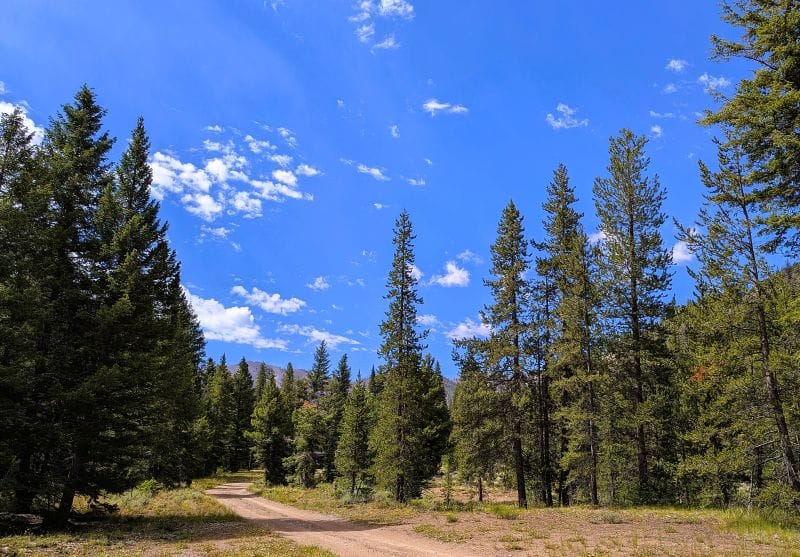
Boondocking does not usually require paying a fee or getting any amenities, except for what a previous camper left behind (fire ring). Usually, your driveway is a dirt path off a dirt road leading to a nearby campsite, without the amenities of a campground. Most boondocking sites are located off of BLM or Forest Service roads.
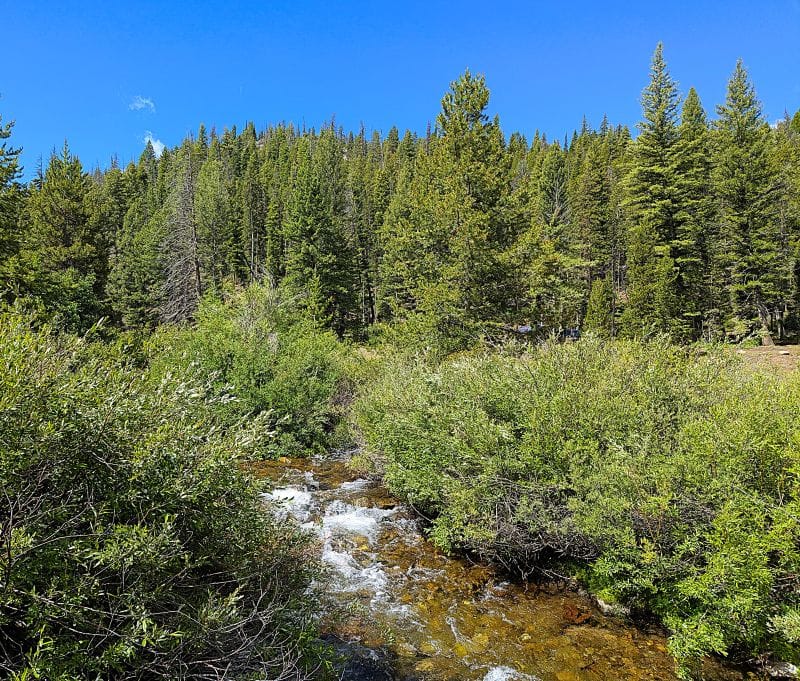
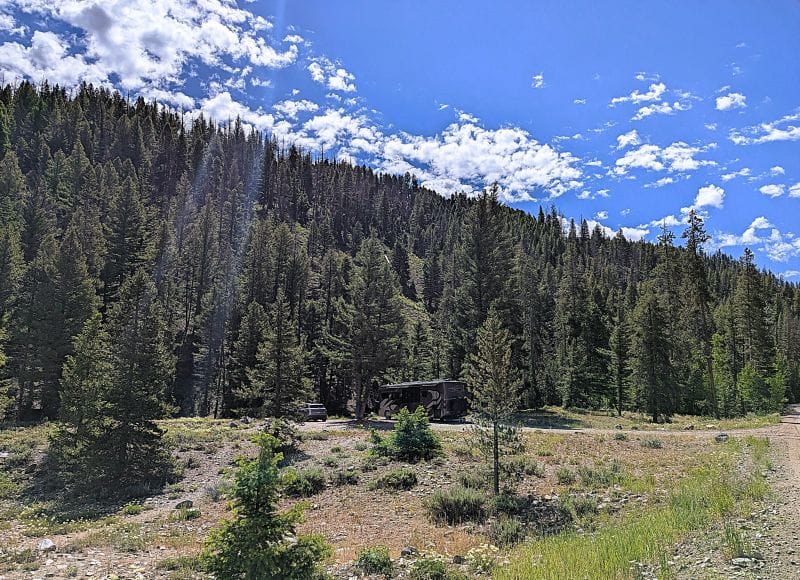
The criteria for us in picking a boondocking site are: is the road good enough, is the site big enough, and is the site level enough to accommodate our large RV with room to park our car. We like sun in the morning and shade in the late afternoon while the day is warmest. Sometimes (maybe usually) you don’t get everything you want. With luck, you will also have the wind direction blowing the dust off the road away from you and the RV.
The locals have a huge advantage.
Locals often know which boondocking sites are the best, and because they know about them, might even set up camp and then leave for a couple of days, coming back for the weekend. While this seems totally unfair to us travelers, no one stops them. Rangers are not doing a midnight drive-by to check and see if the site is actually occupied. Stay limits at Forest Service campgrounds and boondocking sites are getting shorter. They are meant to be recreational sites, not alternative living locations. All boondocking sites are, by their very nature, first come, first served.
Rangers
Typically, rangers know how long a particular site is occupied, but unless it becomes abusive, they rarely care how often the site changes occupants. In the Sawtooth Recreation Area, the stay limits are getting shorter, but we found sites with 16-day stay limits. This isn’t a factor for us because we don’t carry 16 days of water and need to dump our tanks and take on water anyway before the stay limit makes us move on.
At the Sawtooth Recreation Area, the rule is that you must move 25 miles between boondocking sites. This is to keep the sites rotating and not become summer homes for the locals. Our schedule was to stay at the campground for 3-5 days followed by a week of boondocking. After that, we would drive north across Galena Pass to a different part of the recreation area and get a campsite at Alturas Lake. After Alturas Lake, we planned another week of boondocking on the Stanley side of Galena Pass. Anyway, that was the plan.
We used the onset of the mid-summer winter storm to our advantage.
We arrived at the North Fork Campground on Friday, June 26th. I scheduled it this way so that we could find our perfect boondocking site and occupy it early in the week. RVing is still an overwhelmingly weekend activity with most campers leaving on Sunday afternoon. The further people travel to get to these places, the longer they stay. Early in the week is the very best time to find a first-come, first-served campsite in a campground or at a boondocking site.
While at the North Fork Campground, I was keen on finding an ideal campsite in the Sawtooth Mountains to spend the following week. Unfortunately, while at the North Fork Campground, our furnace broke. I mentioned the onset of winter and the cold front, but not yet about the furnace. If you didn’t see the article about our campground furnace repair, here is a link. Winter started at the end of June.
Scouting for boondocking sites
While we are at the North Fork Campground, we could see some boondocking sites nearby, including some near the Sawtooths National Recreation Area Visitor Center. While we were there, while it was raining, we explored some of the area and found that boondocking sites were plentiful.
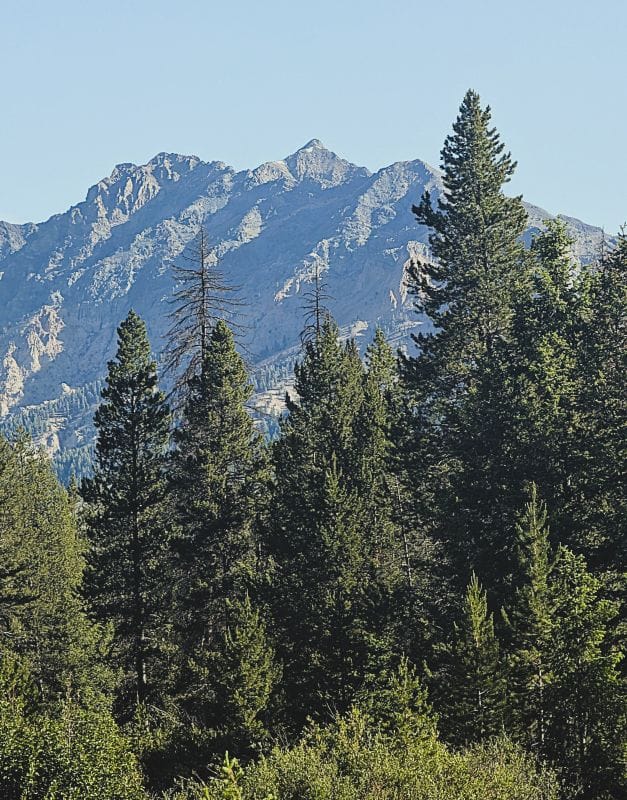
Some boondocking sites were far better than others. On one of these scouting trips, we turned up a Forest Service Road, and about three miles up the freshly graded road, we made a site selection. In that same area, we had alternate choices. The question was whether our first choice would be available after the rain let up.
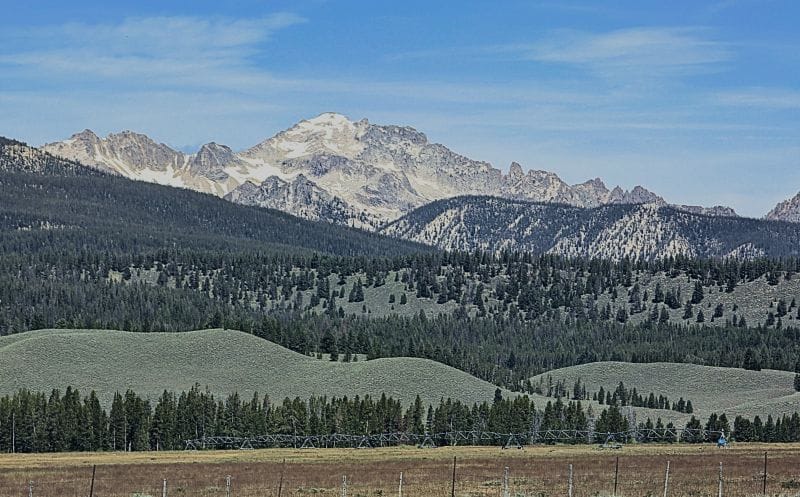
We paid for extra days at the North Fork Campground, and on Tuesday morning we set out to stake our claim at a great boondocking site. Most of the fair weather campers didn’t come out due to the rain. Staking a claim at a boondocking site is done by occupying it. Here we had a problem. We weren’t scouting in our RV, and without our RV, we couldn’t really occupy our site. So to show the site we wanted, I set up our bug tent. I felt pretty ridiculous setting up a bug tent in the rain, but anyone who drove by could see it and “tell” our site was occupied.
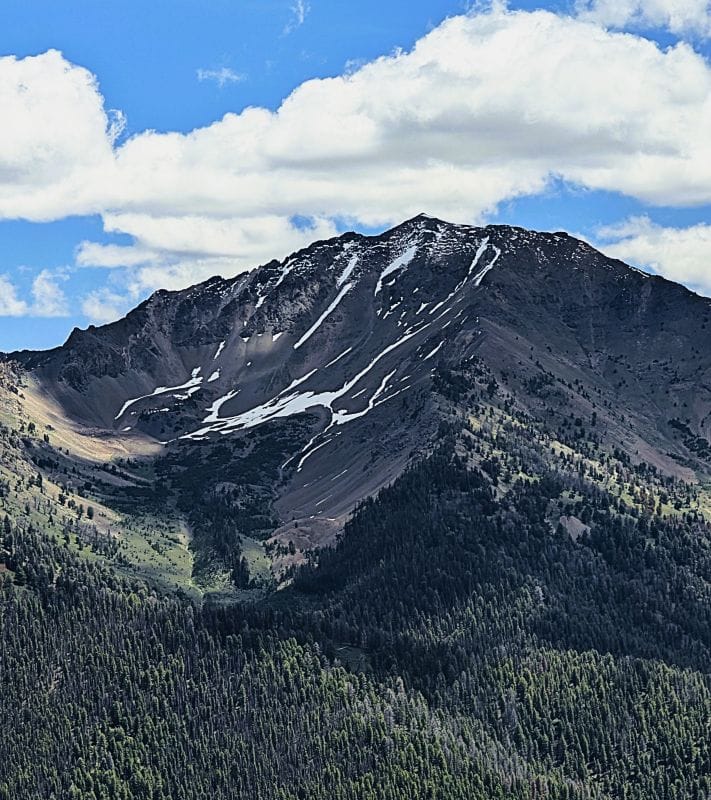
Our bug tent isn’t free-standing, and it wouldn’t take much for a slight breeze to blow it away. In the Rocky Mountains, I have never had much luck with tent stakes. Instead, I have some old nylon sacks that, when filled with rocks, make for a pretty good anchor. If the wind was strong enough, the sacks would drag, and the wind would destroy the bug tent anyway. The bags of rocks should be strong enough to keep the tent out of the trees.
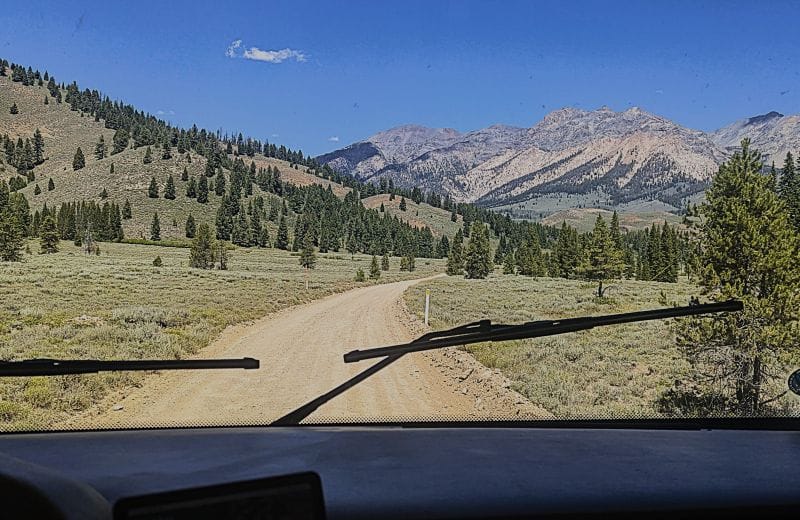
Stronger Rain
After setting up the bug tent, the rain became steadier and more drenching after we got back to our RV. We considered staying in our already paid-for campsite one more night, letting the bug tent do its job keeping the other campers moving. It probably wasn’t necessary, but we decided that it was as good as it was going to get and got the RV ready for the move to our boondocking site.
Before we switched sites, we stopped at the dump station near the visitor center to get ready for our site switch. At the dump station, with even heavier rain, we filled our freshwater to overflowing and were finally ready.
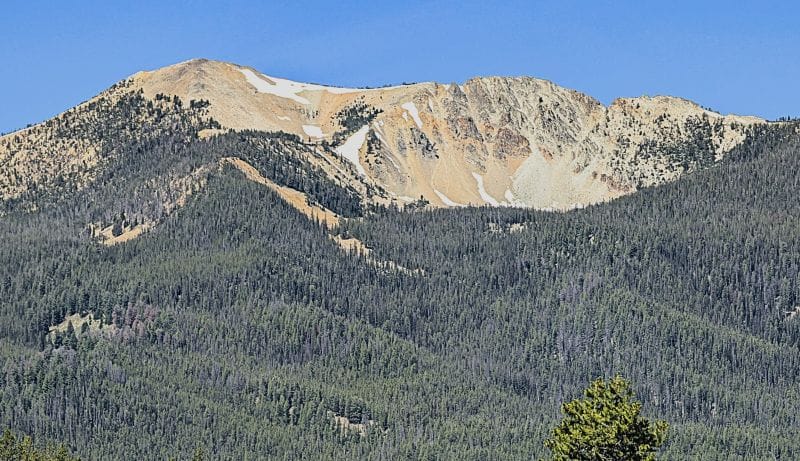
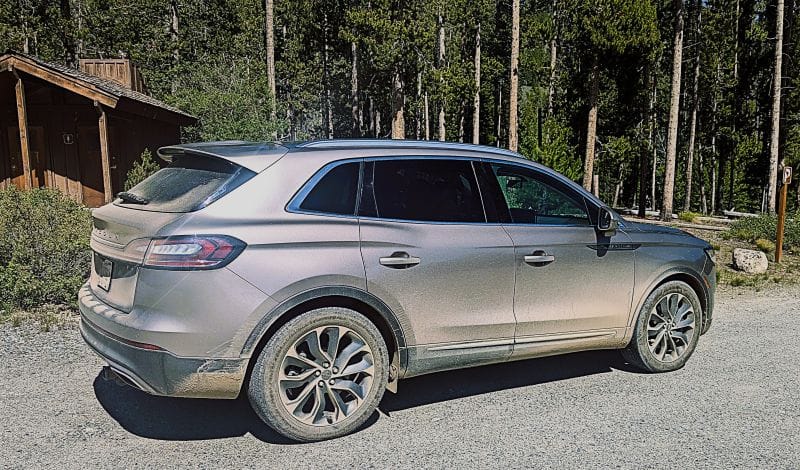
On this little trip of less than a mile to the dump station, we didn’t tow our car behind the RV. This is because it was only a few miles to our new campsite, and the mud the RV kicks up really makes a mess out of our car. Our car was already muddy from scouting; had we towed it, it would have been far worse. At the end of the week in our boondocking site, I used our extra water to rinse both the RV and the car to get rid of the extra mud.
Water is almost never available at a boondocking site. No one tells you what you can or cannot do with your (fresh) water at a boondocking site. If we are in a campground and they have showers nearby and water to fill a bottle or bucket, we can go ten or even more days without extra water for our freshwater tank. To do this, we use the buckets to flush our toilet with the water pump turned off and a bottle of freshwater in the refrigerator for drinking. Our limit at a boondocking site is about a week.
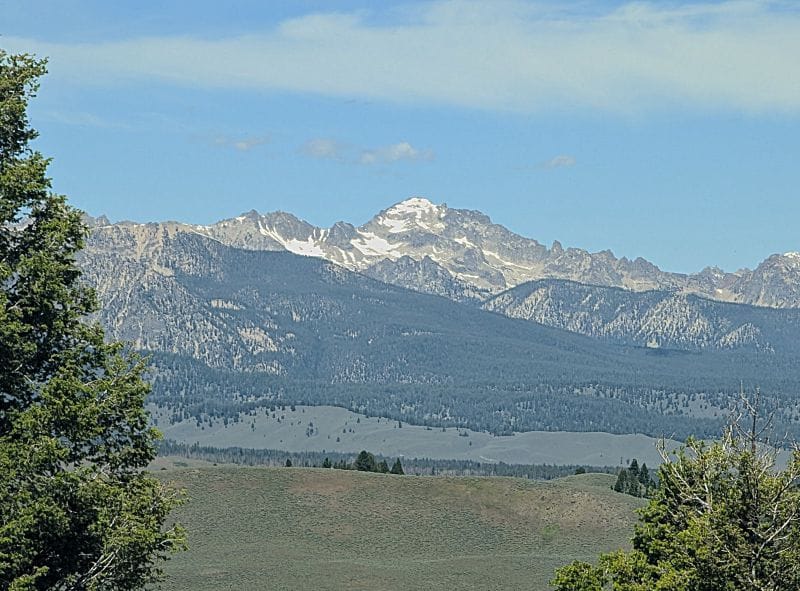
Freshly graded road
The freshly graded road that was dry(ish) in the morning was a series of mud puddles on our way to the boondocking site. Both sides of the RV were covered with mud, as was our car. In this case, I was driving the RV and Tami the car. She followed me at quite a distance. I didn’t realize how much mud I was depositing all over the RV. I probably rutted the freshly graded road a little on the drive in.
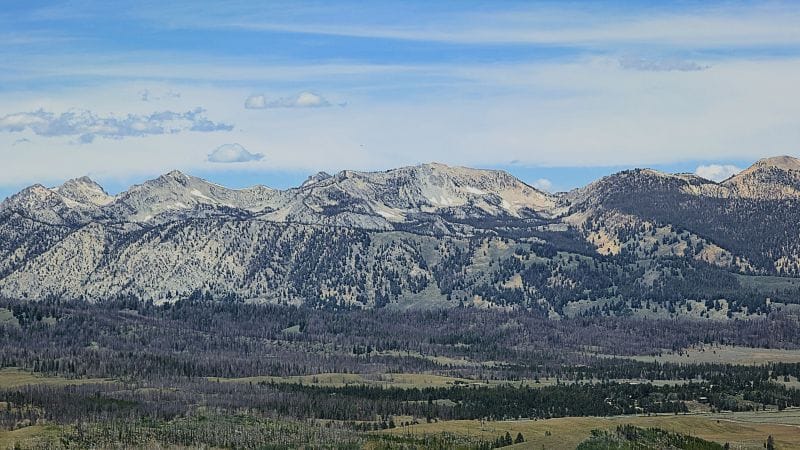
Our bug tent did its job and was still there in the middle of the afternoon, now in a light rain. When we set up, the rain was pretty much over and wouldn’t bother us for the rest of our stay. Our boondocking site was huge, with room for at least three RVs, with cars, and still had enough room to turn a fourth RV around at the intersection. One of the “rules” is that if you see an occupied boondocking site, you don’t pull in, even if there is room, when other sites are available.
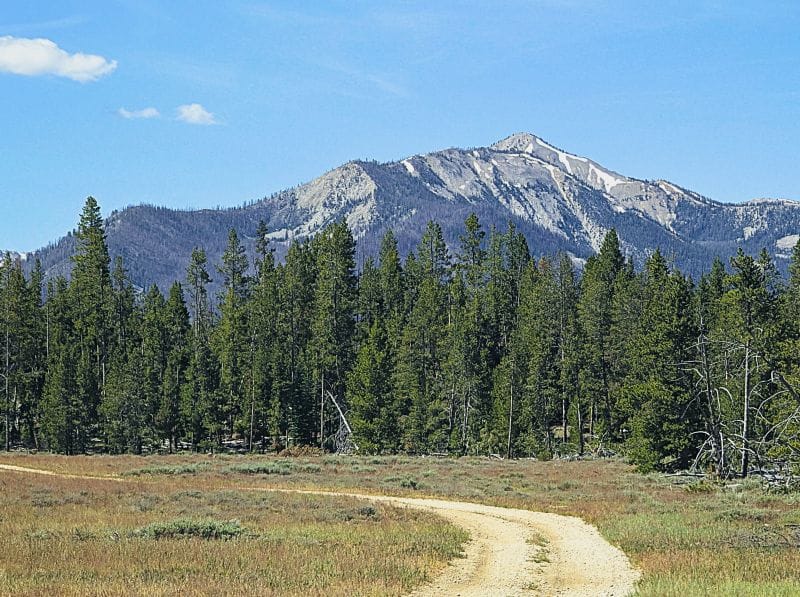
We were facing east, but a mountain prevented us from getting early morning sunshine. We were parked between two huge trees, and the one on the south side protected our RV from the heat but also prevented us from getting adequate power from our solar array. When we pulled into our site, our battery power was about 50%, and since it was still cloudy, with continued rain likely, we weren’t going to get much from the solar array. Dust from the road wasn’t going to be an issue for a few days because of the rain.
Then the generator failed to start
By evening, the battery charge was about 40%, and I tried to start the generator; it didn’t start. The fuel pump sounded strong, indicating I had good electric power to the generator, but the generator didn’t turn over even when trying to start. The fault code indicated the generator RPM (revolutions per minute) was too low. This fault code didn’t help. Had the generator failed when it was running, it may have been helpful. But with the RPM at zero, because the starter wouldn’t even try to start it, the fault code was worthless.
I suspected the rain and maybe mud may have had something to do with the problem. Mud wasn’t a problem because our generator sits in front of the wheels. The splash zone is behind the wheels. The area behind the tires was caked with mud. I checked fuses, but they were fine. These fuses are right next to the start switch. Deeper in the generator, there are a couple of relays, but I couldn’t get to them. There is also the starter solenoid mounted on the starter; this too was not accessible in our boondocking spot.
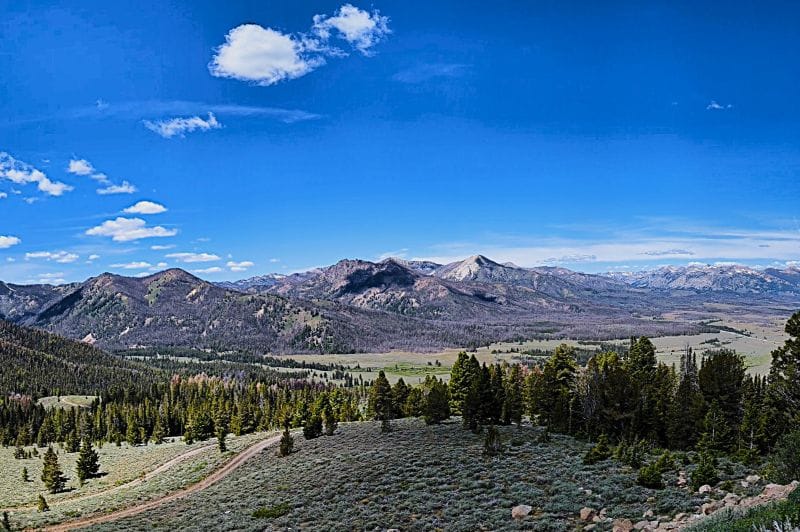
Our solar and batteries did all the work for the next week. Each day our total charge recovered enough so we could make it through one more day. While staying in our boondocking spot, we drove over Galena Pass to investigate our next campsite at Alturas Lake. Alturas Lake was totally unacceptable. We couldn’t even drive our RV through the campground, let alone fit in our campsite. If our generator was working, we would have found a boondocking spot near Alturas Lake, but we needed to charge our batteries back to full and get our generator fixed.
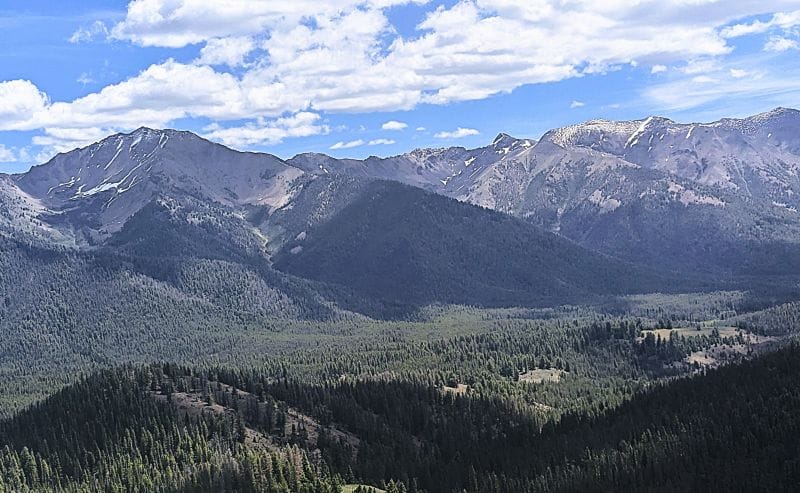
Boondocking for one week with a broken generator
Boondocking for a week with a broken generator would have been impossible without solar and our large battery. While our solar array is the same as it was for the last 6 years, I have a new battery setup with three Lion Energy UT 3500 batteries that have 840 amp-hours of storage, plus one six-year-old Lion Energy UT 1300 that has 105 amp-hours of storage (when new). I knew I would be selling my blue batteries when this happened… here is a link to the story. Our RV electrical failure led to a surprising discovery.
In the future, I will add an additional Lion Energy UT 3500 battery to the setup so that I could, if needed, convert to a 48-volt inverter when our current inverter finally quits. Because the UT3500 is nearly equal to three of my previous blue batteries, most campers would only need one additional battery to convert to a 48-volt system.
I knew I would be selling my blue batteries and working on a repower in August 2024 when I had problems powering my refrigerator while on my Alaska cruise. The cruise was awesome, and I fixed the problem in about 5 minutes after returning to the RV. Here is a link to one of our cruise articles. Back from our cruise to Alaska
When my upgrade is finished, I will have 1120 amp hours of storage in my batteries plus the UT 1300 battery. I sold all the blue batteries to upgrade my system to its current state. Unlike some people who have had issues with the blue batteries, mine were not abused and are still fully functional. I made the decision about my upgrade more than a year ago. Here is a link to my seven-year review article. 7-Year Review: RV Electricity – Solar Power and Lithium Batteries
About that bug tent
Oh, one other thing about getting our boondocking site. I mentioned that we set up our bug tent as a symbol that our site was occupied. Setting up our bug tent is always difficult, especially this time during the rain. It wasn’t until the next day that Tami saw that somehow I managed to set up the bug tent inside out. Perhaps that is one reason it was so difficult.
Please subscribe and join us on our journey
We will add you to our email list and send you updates once a week. Here is a link. Subscribe
About our links
As you know, our blog income is zero – this allows us to be independent and just tell the truth. We do not get income or commissions. No, we don’t make paid endorsements. We don’t make recommendations, but instead, we will tell you what we like (or dislike). The links are only provided as a quick reference to help our readers.
Links
North Fork Campground, Sawtooth Recreation Area
Sawtooth National Recreation Area
Lion Energy UT3500 Lithium Iron Phosphate Battery
About Comments
We love seeing your comments, but they are not automatic. I get about 20 spam comments every day, so I don’t allow automatic comments. I read and personally publish every comment to protect the blog and keep it on topic and real. This means you won’t see your comment right after you hit submit. Sorry for the delay in publishing your comments. Please know that we love hearing from you.
I’d really like to see more details about your new batteries.
Your story makes me want to visit this area!
Pingback: Boondocking with our new batteries after our generator died. - FoxRVTravel
Thank you for sharing your adventures and photos.
Pingback: Then our generator failed. - FoxRVTravel