

For the last two weeks, we stayed at some wonderful campgrounds that had crappy 30-amp power. Last week, the 30-amp power was so crappy that I didn’t plug in to the pedestal. We have a large RV and prefer 50-amp power at a campground. But my RV is better prepared to operate on limited 30-amp power than most big RVs. I am very happy we were able to be comfortable even though the campgrounds had crappy power.

Pinnacles National Park and Monterey
Both campgrounds have electricity, unlike some places we stay that have none. Pinnacles National Park is very remote, and Monterey Pines RV Park is in the middle of the city of Monterey. The remote campground had crappy power, and our current campground at Monterey has dangerous, 30-amp power. At both campgrounds, the views are very nice, and the areas are entertaining. We made it work, but it was harder than it needed to be because of the crappy 30-amp power supply.

30-amp power isn’t really the problem
The 30-amp power becomes a problem if the campground doesn’t maintain its system. Some campgrounds have undergone major remodels and installed 50-amp power, but it is not universal. We have seen more neglected campgrounds with only 30-amp power. Both campgrounds we stayed at over the last two weeks were neglected. 30-amp power delivers far less usable energy than 50-amp power.
The difference isn’t 20 amps; it’s 70 amps. This is because if you have 50-amp power, you have two 50-amp feeds and can use up to 100-amps at any time. When you have 30-amp power, you have a single 30-amp feed. 30-amps is all you get. Quick math break: 30-amp power x 120 volts = 3600 watts; 50-amp power x 2 legs x 120 volts = 12,000 watts.
A question of neglect
Both Pinnacles National Park and Monterey Pines RV Park have neglected their electrical systems, and neither provides a proper 30-amp power supply. Both had different reasons for their power being inadequate, or, in the case of Monterey Pines, their 30-amp power supply was dangerous.

I complained at Monterey Pines, but as for Pinnacles National Park, they already knew their power was inadequate. In fact, Pinnacles National Park is the only campground I have ever seen with 50-amp wiring and receptacles but no 50-amp circuit breakers. My conclusion is that they found out they couldn’t support 50 amps and turned it off. They are moving backward because of their power supply. Complaining at Pinnacles would have fallen on deaf ears and been a waste of my time. At Monterey Pines RV Park, complaining yielded no changes during our stay.
If you don’t check, you won’t know
In the last eight years of living in our RV full-time, I have seen some crappy electrical systems, but it doesn’t have to look bad to be bad. The only way to know if you have a crappy electrical system is to check it with a voltmeter. This test is the bare minimum. When testing 30-amp power, you test the hot and neutral wires. When testing 50-amp power, you test both hot wires and the neutral wires one at a time.

I use the lowest-priced voltmeters for this check because they break. I think I have broken multiple voltmeters by checking campgrounds with dangerous electrical power. I stopped using my expensive voltmeter for this test because it had recently stopped measuring voltage correctly. I had to send it back for a repair. Remember, using a voltmeter is like taking a photo: it only shows the voltage at that moment, and voltage can change with use. Even though the initial voltage meter check looked fine, at Pinnacles, we used the electrical system for hours before we discovered the real problem. At Monterey, I knew I probably couldn’t use the electrical system the moment I checked it before I plugged in the RV.
Pinnacles National Park
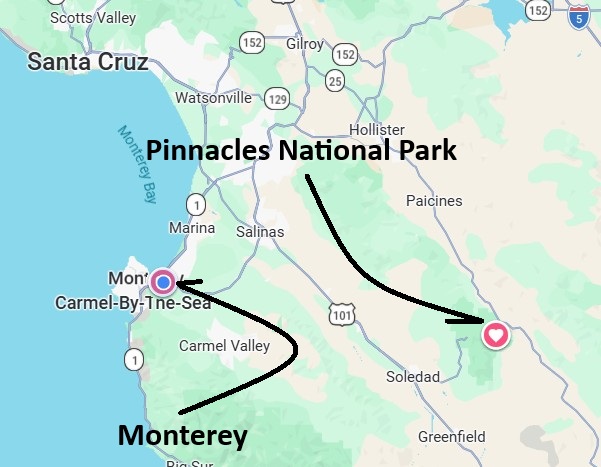
Pinnacles National Park is only 20 miles to the east of Monterey if you are a California Condor. In fact, Pinnacles National Park is the home of the newly released California Condors, and we may have even seen some circling high overhead. Or they may have been Turkey Vultures. I couldn’t tell; they were pretty far away, and both are large birds. Since we are not birds and were driving our RV, the driving distance was 93 miles.
Getting to Pinnacles National Park
Driving these 93 miles was the easy way to get to Monterey from Pinnacles, and went north through Hollister and Salinas. We drove from San Luis Obispo to Pinnacles, and the distance was about 117 miles, but I have to warn you that there is a small stretch between King City and Bitterwater (15 miles) that was pothole hell.
Even the main road north of Bitterwater wasn’t at all fun because it was narrow. As a traveling tip, a good way to tell if a road is unusually narrow is to use Google Maps Street View. If Street View, on a straight section, doesn’t have dotted lines permitting passing, then you probably have a narrow road. If Street View doesn’t show a white line at the edge of the road, you definitely have a narrow road. The road from King City to Pinnacles National Park wasn’t too narrow for us, since we were almost the only vehicle.

Power problems at Pinnacles National Park
The reason the 30-amp power was a problem at Pinnacles National Park is that it was very warm, and our RV was sitting in direct sunlight in the afternoon. In fact, other than our trip to Singapore, Pinnacles was the warmest place we have been this year. At Pinnacles, it was warm, even in the shade. As the temperature climbed, RVs started using their air conditioners, and the campground voltage sagged. The same thing happened in the morning when RVs were using their heaters.

Pinnacles has a voltage problem. In the morning and afternoon, the voltage was below 110 volts, and the circuit breaker tripped at about 20 amps. At Pinnacles, we could only draw about 15 amps from the 30-amp circuit breaker before it tripped.
What is normal voltage?
In the United States, the standard voltage is between 110 and 120. 120V is nominal (in name only) per some IEEE articles, and 10% +/- is generally acceptable, which gets you the 108 – 132. Thus, 108 would be considered within tolerance for the lower end. On the high end, up to and including 124-126 won’t hurt anything. I will address high voltage in more detail later and explain why voltage matters.

What happens when the voltage drops?
The issue at Pinnacles is that the voltage would frequently dip to an unacceptable low voltage. Drawing the same load at a higher voltage generates more heat in the circuit more quickly, even if your device’s wattage doesn’t change. Here is a quick example. A water heater drawing 1500 watts at 120 volts creates a 12.5 amp load. (The formula is watts/volts=amps) The same water heater, drawing 1500 watts at 100 volts (yes, I saw 100 volts at Pinnacles), creates a 15-amp load. Remember, I tripped the weak “30-amp” circuit breaker while drawing way less than 30 amps. This math explains why.
Why circuit breakers trip
Circuit breakers trip based on the heat generated by the current flowing through them. The heat might be nearly instantaneous, or it might (as it was at Pinnacles) trip based on the current drawn over a longer period. I tripped the 30-amp circuit breaker at Pinnacles without ever drawing a full 30-amp load. Looking at the 30-amp circuit breaker, you could tell it wasn’t recently installed.

Correcting for low voltage inside our RV
We corrected for the low voltage at Pinnacles National Park for our RV using our Hughes Autoformer voltage booster. We can boost the voltage by about 10%. I will explain more later.
You may have read my previous post about the Hughes Watchdog Power Center on my blog at this link. Our new Watchdog Power Center offers complete protection. Or you may have read a rewrite of this same article inside the Escapees magazine, or maybe you already knew about the Hughes Autoformer from my 2022 article at this link. Correct Campground Voltage. My 2022 article was reprinted in the Family RVing magazine. Perhaps you caught my article about burning out my surge protector last January. Here is a link to that article. Our surge protector died while protecting our RV. Again, the Escapees Magazine republished that article.

Of course, my Watchdog Power Center cannot fix the low voltage at the pedestal, but it can protect my RV from low voltage. The Watchdog Power Center can’t fix a weak circuit breaker, and I unintentionally tripped the 30-amp circuit breaker on the pedestal numerous times. Sometimes we tripped the circuit breaker without turning anything extra on because fluctuations in the campground’s voltage caused an overcurrent. I couldn’t use more than one of my major power devices at a time. I tripped the circuit breaker by having the battery charger on and then starting the microwave, and other combinations never equaling 30 amps.

To avoid tripping the 30-amp circuit breaker, I turned most everything off except the one item I wanted to power, and I tried not to use the microwave unless I first made sure nothing else was using electricity. This worked, and we were able to run one of our air conditioners, and nothing else, to keep the RV cool while we were at Pinnacles.
No notice of power failures
One of the problems with my RV is that the inverter takes over immediately whenever power fails, and if I am not watching closely, I don’t notice the transfer. With the exception of the water heater, I can run every normal electrical load from my batteries. I just can’t run everything all at once.

A better inverter would help
One feature of newer inverters is that they can combine power from the batteries with power from an external electrical source. As for the newer inverters, they may continue to operate their RV while drawing more than 30 amps from the campground pedestal, exceeding the campground’s electrical system limit. They wouldn’t be tripping the circuit breaker for the same reasons as I do. They can combine the electricity from the pedestal and the batteries. My RV is either one source or the other, not both. Since my 30-amp circuit breaker was failing at less than 20-amps, an RV with one of these new inverters wouldn’t have tripped even a 20-amp circuit breaker.
Dangerous 30-amp power at Monterey
Monterey had only 20- and 30-amp power, while most RV parks in this price range offer 50-amp power. Monterey is stuck with only 30-amp power. Upgrades to Monterey didn’t include fixing the electricity. Lots of new pavement means upgrading to 50-amp power will be much harder.
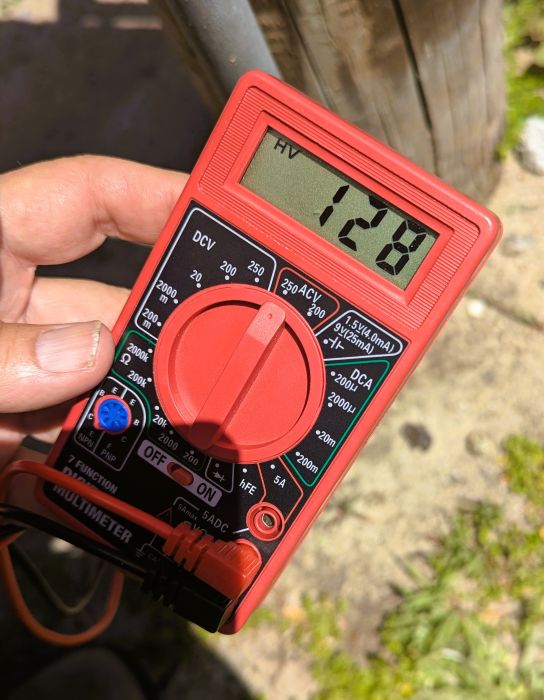
At Monterey, I had the opposite problem as at Pinnacles. At Monterey, we had dangerous 30-amp voltage, really high voltage. Remember, I mentioned that perhaps 124 volts was the maximum normal voltage margin. We never saw anything close to 124. When we arrived, the voltage was 129 and occasionally 130. I even caught a brief spike at 136 volts. 130 volts is dangerous to small electronics, and 136 volts is in the range that can start an electrical fire. It doesn’t matter whether the power is 30 amps or 50 amps; high voltage is immediately dangerous.
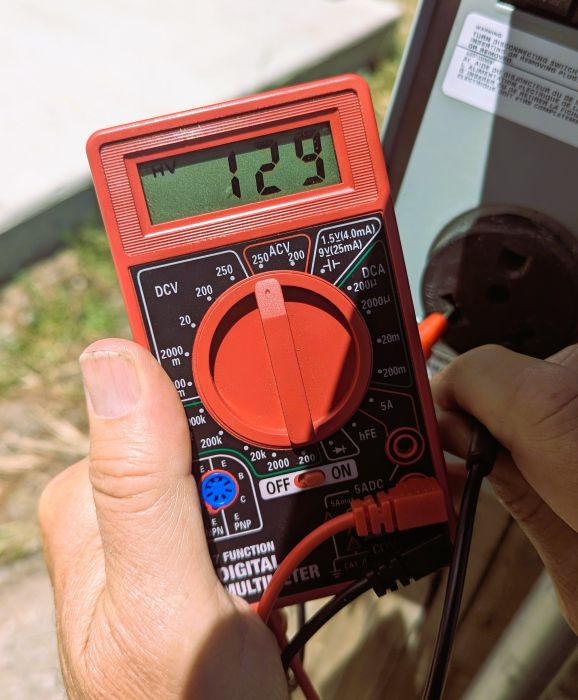
Here is a Google AI overview quote about high voltage. “High voltage in a home (consistently over 126-130 volts for a 120V system) is a serious issue that can damage electronics and pose fire risks. Common causes include utility company issues, faulty transformers, or a lost neutral connection.”
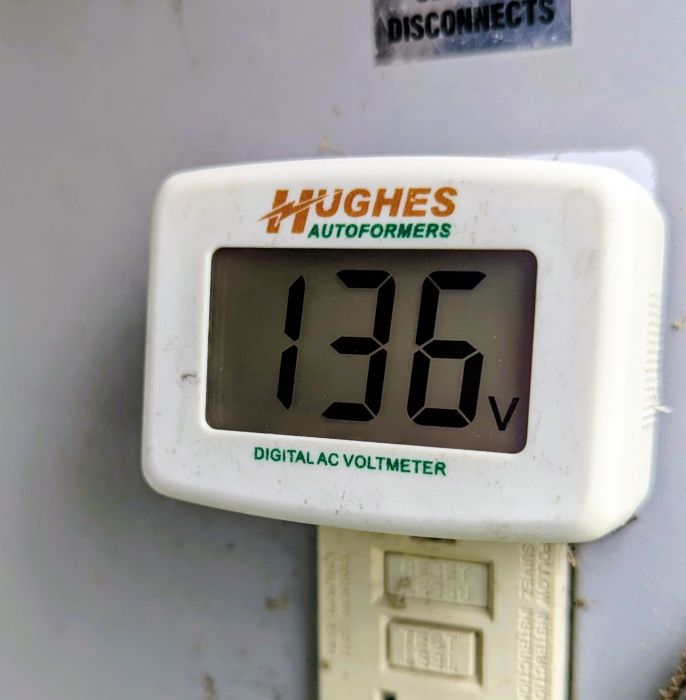
I might add that high voltage is an indication of a transformer failure, and we have a buzzing transformer right next to us. High voltage might also be associated with or cause a loss of neutral. Here is another Google AI quote about a lost neutral. “If some circuits are very high (>130V) and others are very low (<100V), you likely have a ‘lost neutral’ connection, which is an emergency and poses fire risks.”
Here is some more really bad news: a lost neutral connection dramatically increases the risk of electrical shock. Instead of using the neutral wire, the electricity may be routed to the nearest ground. You could be severely shocked (and killed) by merely picking up an appliance.
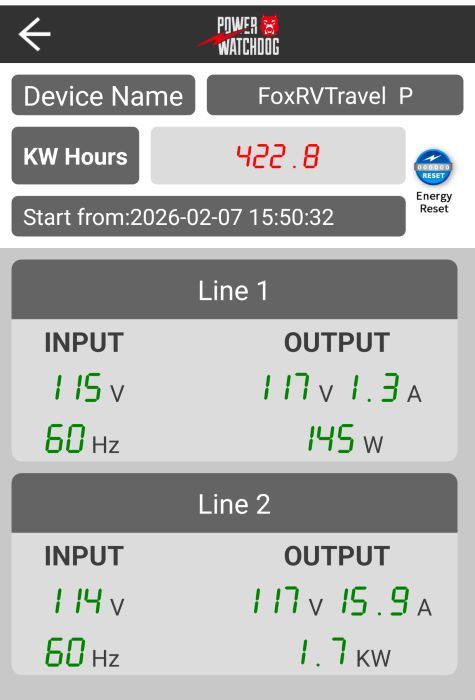
By monitoring the voltage with multiple devices, I determined that I was unwilling to risk plugging our RV into the power at Monterey, even though we always use a Hughes Watchdog electrical management system that will protect our RV from both high and low voltages. Our Hughes Watchdog has an Emergency Power Off function that prevents dangerous electrical power from reaching our RV.
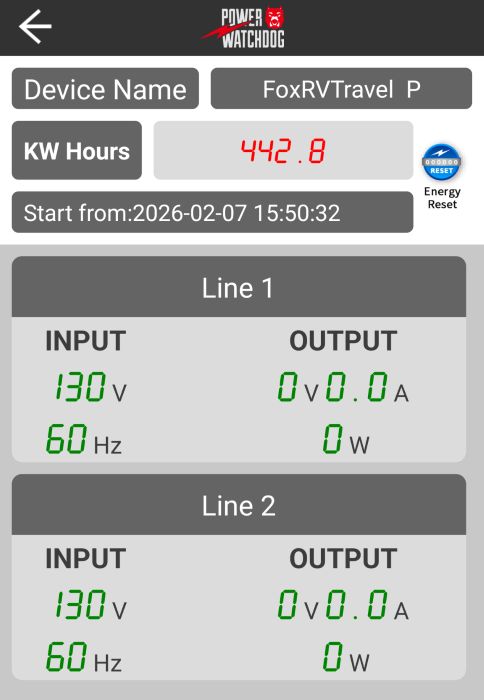
Here is the rub and perhaps the reason why the campground didn’t correct the problem. I was the only one who complained that the voltage was too high, and I checked it with three different voltmeters. The other campers I met didn’t know the voltage was too high. They were plugged in and living as if it didn’t matter that the voltage could damage their electronics or even start a fire. They knew yesterday when the power went out and immediately got out of their RVs to check the circuit breakers on the pedestal.
What did we do without using the dangerous 30-amp power?
I checked the voltage perhaps 20 times during our stay at Monterey, and instead of plugging our RV into the crappy 30-amp power, we acted as if we were camping without outside electricity. We met all our electrical needs with our batteries and recharged them every day using our solar array.

Even though the solar panels were not oriented correctly, they generated enough power to replenish the power used during the day and the previous evening. The key to doing this is that we didn’t need air conditioning while we were staying in Monterey. Even then, I had managed things more closely. If I were careful, I could have kept our air conditioning running each day without electricity from the outside.
We had a great time in Monterey
Even though I was unwilling to plug in my RV, we had a great time in Monterey, and it wasn’t our first visit. All the pictures in this article were taken during our visit to Pinnacles National Park. Next week, I will tell you about some of the things we did when we were in Monterey. As with our previous visits to Monterey in 2019 and 2023, it is stunningly beautiful. If you want a peek at things in Monterey, you could go to my previous post on the subject. Our Visit to Monterey, Stunning Photos and Underwater Videos.
Please subscribe and join us on our journey
We will add you to our email list and send you updates once a week. Here is a link. Subscribe
About our links
As you know, our blog income is zero – this allows us to be independent and just tell the truth. We do not get income or commissions. No, we don’t make paid endorsements. We don’t make recommendations, but instead, we will tell you what we like (or dislike). The links are only provided as a quick reference to help our readers.
Links
Watchdog Power Center 50 amp with Wifi and Bluetooth
Watchdog Power Center 30 amp with WiFi and Bluetooth
Power Watchdog EMS w/ EPO 50 amp
Power Watchdog EMS w/ EPO 30 amp
About Comments
We love seeing your comments, but they are not automatic. I get about 20 spam comments every day, so I don’t allow automatic comments. I read and personally publish every comment to protect the blog and keep it on topic and real. So what this means for you is that you will not see your comment right after you hit submit. Sorry for the delay in publishing your comments. Please know that we love hearing from you.
We love our Watchdog. I had one park that showed good power at 115 volts, but when I turned on our AC, the Watchdog shut off because the power was dropping down to 100 volts. Come to find out, the park had run a 12/2 wire from another pedestal to mine, which was over 75 feet away. Watchdog saved us. You can’t trust any of these parks. Better safe than sorry. Looks like a really nice area to visit and hike. Thanks for sharing!
Your article about the Autoformer alerted me to your blog, which has been interesting, entertaining, and informative.
I am now in Michigan for the Memorial Day holiday. The campground is filling up, and I rest easy, knowing my RV is protected.
Pingback: Our spectacular 2026 spring trip. - FoxRVTravel