

Small solar panels are rated at less than 100 watts of power. In this article, I will explore their usefulness. You may think they are the lowest-cost solar panels available, but they are actually the most costly solar panels in terms of price versus performance. Some small solar panels are novelties. Originally published on May 1, 2025, updated on August 28, 2025, to include testing over 4 months with no outside electrical source.
Table of Contents

In this article, I will explain how to utilize small solar panels to generate useful power.
My large solar array
My RV has eighteen 100-watt solar panels (partial photo above) and one 12-watt solar panel. The 100-watt solar panels provide enough electricity for my entire RV, except for full-time air conditioning. The small 12-watt solar panel is connected to my engine (chassis) battery as a life extender. I also transfer power from my house battery bank to my engine battery using a DC-to-DC charger to ensure it is fully charged and ready to go at all times.

What are small solar panels?
In terms of size, my 100-watt solar panels are small solar panels. This article focuses on solar panels smaller than my 100-watt solar panels. My 100-watt solar panels are small, but I wouldn’t call them small solar panels, as I’ve wired them to act as larger ones. Instead, each of the three small solar panels acts as one larger 300-watt solar panel.
Making Small Solar Panels Useful.
Remember, I promised to tell you how to make small solar panels useful? Wiring them together to act as one panel is the trick to make small solar panels useful.

Be careful when wiring the panels. Increasing the voltage will create a very severe shock hazard. The same applies to wiring in parallel; the extra amperage can cause increased resistance in the wires, causing heat and possibly burning them. If you reconfigure the wiring, you’d better know exactly what you are doing.

I chose eighteen 100-watt solar panels to position around all the objects on my RV roof. Since my roof has air conditioning units, skylights, and antennas, I couldn’t use large solar panels to achieve the same coverage. The 100-watt solar panels fit between the other objects, and I was able to install them so that no shadows are cast on any of my solar panels by objects on my roof.
I have about 30 articles at FoxRVTravel about operating our RV on electricity produced from our solar panels. Here is a link to a long-term review article. 7-Year Review: RV Electricity – Solar Power and Lithium Batteries
This article is about solar panels smaller than 100 watts.
Solar panels are rated in terms of watts at peak performance. At peak performance, my solar panels produce 100 watts each. However, due to orientation and sky conditions, my solar panels rarely produce peak performance. Even if I achieve peak performance on half my array, the others will not be at peak performance. Instead, the highest performance is usually only 70 watts per panel. Often, the solar array performance is less than 50 watts per panel.
The best I can ask for is optimum performance on half of my panels. This will only happen in the summer when the energy is already abundant, with the sun high in the sky. In the summer, charging days are also much longer.

Panels smaller than 10 watts
The performance results of my large solar array are important to know about because all small solar panels work the same way. A ten-watt solar panel will only achieve seven watts or less energy unless you constantly align it to the sun. Four or five watts is more typical. And you will only get 4-5 watts if the battery needs the power. If the battery does not need power, the electricity is wasted.
Small solar panels of less than 10 watts can maintain the charge of small electronic devices when in use. They could recharge a device, but it would take a very long time. I have some small solar panels on a flashlight. These solar panels would take days (perhaps weeks) to recharge my small flashlight.
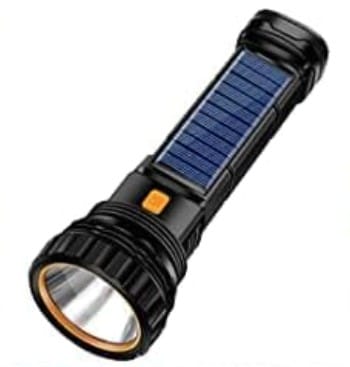
Don’t expect small solar panels to recharge your e-bike, power small appliances, or support emergency backup power. Sometimes, they provide practical and cost-effective solutions for various needs.

Security Cameras
The exact components of a solar-powered security system can vary. Still, a typical setup generally consists of a mini solar panel (or multiple panels), a battery storage unit, a charge controller, and security devices (such as cameras and motion sensors). For security, a 30-watt solar panel, combined with a 12-volt battery, can operate security cameras.
Backpacking
Camping and hiking are perhaps the most common uses of portable solar panels. You will be much happier if you fasten larger panels to the top of your van or RV to provide an alternative to a portable generator.

A 20-30-watt panel with a battery could operate a small LED light at night and recharge the next day. Of course, you would probably want a controller to turn on the light only at night. The LED bulb is unlikely to produce any useful light when observed during the daytime.
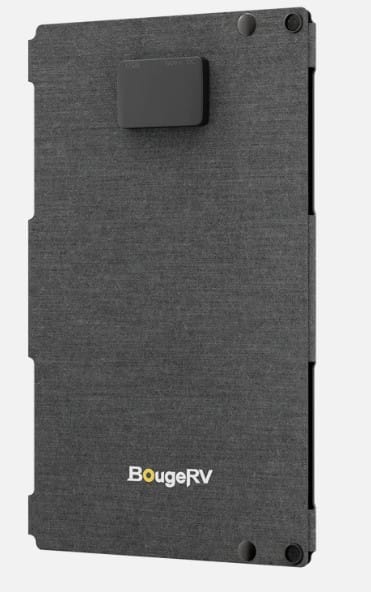
If you’re on a week-long hiking trip into the backcountry and want to keep your phone charged for emergencies, a small solar panel that slips into your backpack can keep you in contact with civilization. You will be much happier with a backup battery to recharge your cell phone. It would take a long time for a small solar panel to recharge your (tiny) cell phone battery.
Directly charging laptops is not feasible with most small solar panels.
Most laptop computers, for example, require 19 volts of constant power, so don’t expect a small solar panel to recharge your laptop computer unless you string several small solar panels in series to get the correct voltage. When you do this, you will need a charge controller.
Sizing a Battery
To maintain a car battery’s charge effectively, you must anticipate the device’s usage. On an unused car, a little flashing LED light can eventually kill a car battery. Lead-acid 12-volt batteries can deplete their charge even when not in use. Assuming you can expect direct sunshine for about four hours every three days, you should size your battery to have an available charge after three days. Then, you should size your solar array to recharge the entire consumption on the charging day.

Solar panels without batteries
Solar panels alone do not make a functional system. You need both solar panels and a place to store the electricity.
Power boxes (Solar Generators)
Small solar panels benefit those who need a small amount of electricity in remote areas. The powerbox is a compact solar system with built-in batteries and charge controllers. Sometimes, these power boxes are referred to as solar generators. Hook this power box to a 50-watt solar panel oriented towards the sun, and you can do some recharging. Some (perhaps most) of the power boxes have built-in alternating current inverters, so you can run standard household devices directly from this all-in-one power box.

50 watts on a solar panel is minimum (for me)
I think the smallest panel you should buy is 50 watts; however, panels operating at 20 watts have some applications as long as your expectations are not too high. For example, a small panel can maintain the charge on a battery when it isn’t in use. Anything smaller than 50 watts doesn’t give you the performance you desire.
If you get a 50-watt solar panel, you will nearly always need a solar charge controller.
My small solar panels
I have two different types of small solar panels. I have a BougeRV folding solar panel, along with both the Zamp Obsidion 25 and 50-watt versions of my 100-watt solar panel. The most significant difference is that my Zamp Obsidion rigid solar panels weigh much more than my BougeRV Panel due to the glass. My 50-watt Zamp Obsidion solar panel is mounted on the roof rack of my car, while the BougeRV panel is portable. Both have the same ability to create 50 watts, but are lucky to produce only 35 watts of power. Both solar panels need a charge controller to protect the battery from high voltage and overcharging.
Why I wanted small solar panels.
As you probably know, I am on an epic train journey through Europe. This means my car is parked unattended and without a source of electricity for more than four months. My car is sitting idle, unused, which is very hard on the battery. I assume you know it will die early unless you use or charge a car battery nearly daily. When we return from Europe, I hope my car starts and that my battery is sufficient to get me home without needing a replacement.

The next photo shows my solar panel positioned behind the windshield. The orientation remains the same, and placing the panel at a lower angle significantly impacts the output. Part of the loss was due to the windscreen, and part was due to the lower angle of the panel. The further you get from the correct alignment, the lower the energy produced by the panel.

Given that my car was parked and my orientation was nearly perfect, I knew from my experience with my large solar array that my 50-watt solar panel would produce only about 200 watt-hours of energy each day, even in March, if the car were parked with the panel fully exposed to the sun.
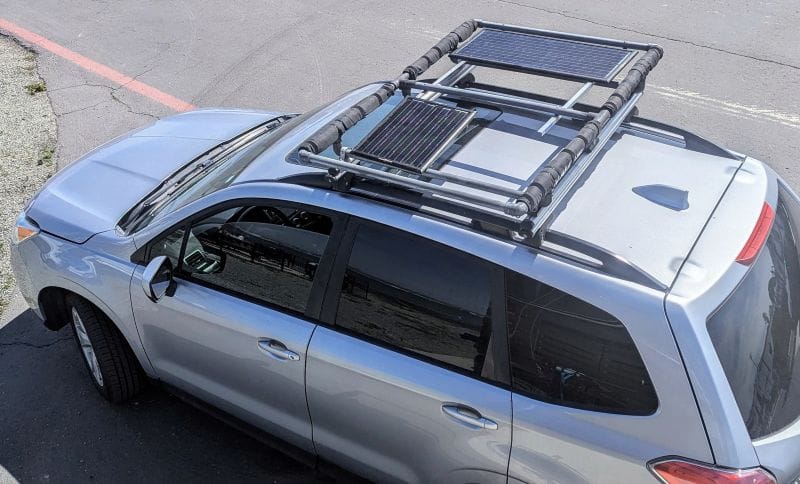
Before my testing, I knew that a 10-watt solar panel, either flat on my car roof rack or behind my windscreen, with the same orientation, would produce only 20-watt hours of energy each day. Perhaps 20 watt-hours might be enough, especially since summer days are longer. In the summer, you might get 40 watt-hours each day. By choosing a 50-watt solar panel, even when placed behind my window, I am sure that it is big enough to keep my battery healthy.
Wiring my small solar panel
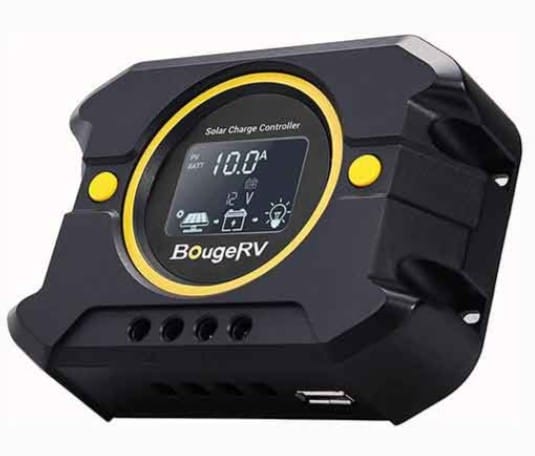
Since my one 50-watt solar panel was “too big,” I needed a solar charge controller. The open circuit voltage on my 50-watt solar panel was over 20 volts, which is too high for a 12-volt (nominal) car battery. The required voltage is approximately 13.5 volts. Thirteen volts is not sufficient, and 20 volts is too high. A voltage that is too high can cause the acid solution to boil out of the battery and potentially damage the battery case.

The barrel connector, connected to the charge controller, is the only port that will allow you to achieve the full 50-watt potential. I am a little suspicious of the wire size on the barrel connector, but time will tell if it is big enough.
The charge controller’s maximum output is regulated to the correct voltage and amperage to maintain a full charge on the car battery without providing too much voltage or overcharging the battery.
How well does my small solar panel work?
It seems to work fine, but the proof will be when I return from Europe, and the car either starts or fails to start. For now, I will return to my four-month trip across Europe. I will update this article to include any insights I gain once I have the final answer. Hopefully, the car will start when I get back.
Four-month test results
My car started right away. Before I attempted to start it, I checked the battery voltage, and it was right at a fully charged 12.6 volts. This was after four months sitting in the sun with the solar panel facing the wrong direction. The car, including the windshield and solar panel, was completely covered with grime. The dirt was expected.
Conclusion
I chose the 50-watt panel to charge my car during our four-month trip through Europe because I was certain that it would yield perfect results. My 50-watt solar panel was ample to do the job. If you are going to do something like this, you need to know if your design is ample and not just adequate. Perhaps if I had used my 25-watt panel, pointed it in the wrong direction, and covered it with grime, I might not have been successful.
Would I do it again? Yes, I would, honestly, my car battery fared better than two other vehicles parked indoors, hooked to a small trickle charger. Charging the car battery while it was sitting outside for four months was a straightforward solution that didn’t require electricity from an external source.
Caution: If you plan to use a 50-watt panel, you must have a charge controller to protect your battery from high voltage and potential overcharging.
Please subscribe and join us on our journey.
We will add you to our email list and send you updates on a weekly basis. Here is a link. Subscribe
About our links
As you are aware, our blog’s income is zero, which enables us to remain independent and tell the truth. We do not get income or commissions. No, we don’t make paid endorsements. We don’t make recommendations; instead, we will tell you what we like (or dislike). The links are only provided as a quick reference to help our readers.
Links
BougeRV 50W Fiberglass Flexible Portable Solar Panel
BougeRV 10 amp charge controller
BougeRV JuiceGo 240Wh Portable Power Station (Pure Sine Wave)
About comments
We love seeing your comments, but they are not automatic. I get about twenty spam comments every day, and thus, I have to turn off automatic comments. I read and then personally publish every comment to protect the blog and keep it on topic and genuine. You will not see your comment right after you hit submit. Sorry for the delay in publishing your comments. Some comments come from personal emails and Facebook. Please know that we would love to hear from you.
Before I got into too many repairs, I decided to wire it for solar. I am binge-reading your posts and can’t stop. I need help, but I will get to that later. Thank you very much; you are opening my eyes to things I don’t know.
Great analysis.
Great article
Pingback: Our car quit at the worse possible time. - FoxRVTravel
Pingback: Our 2025 adventure took us halfway around the world. - FoxRVTravel
This article really helped me understand how small solar panels can still be useful! I didn’t realize that even a 50-watt panel can keep a car battery charged for months when parked outside. It seems like the charge controller is really important to protect the battery, too. For someone starting with a small panel setup, how do you know what size of battery and controller is best to match it?
Any panel over 10 watts would benefit from a charge controller. For a 50-watt solar panel, a 10-amp charge controller is much larger than you need. Recharging is very different from maintaining a charge on a battery. If all you want to do is keep a charge, 20-watt solar panels could do that, unless you live in Maine or Alaska. If you want to recharge, the minimum is 50 watts.