

I have wanted to visit Crater Lake National Park for as long as I can remember. I remember seeing pictures of the volcano when I was in grade school. It is a lake on top of a mountain, with no streams into or out of it, and it is filled with crystal clear water. Crater Lake is also the deepest lake in the United States, even though it is parked atop a mountain. Crater Lake is almost two thousand feet deep.

Our first visit to Crater Lake during our full-time RV journey was in the spring of 2018. Actually, we were there in May, and we were not the first visitors, but we were there before the campground was open, and as you can see from the pictures with the abundant snow, we were some of the first visitors in 2018. If you are looking at a photo from fall 2024, the grass has died, and no snow is found anywhere.
Thank you for all the comments in 2018. This rewrite improves the pictures and story.
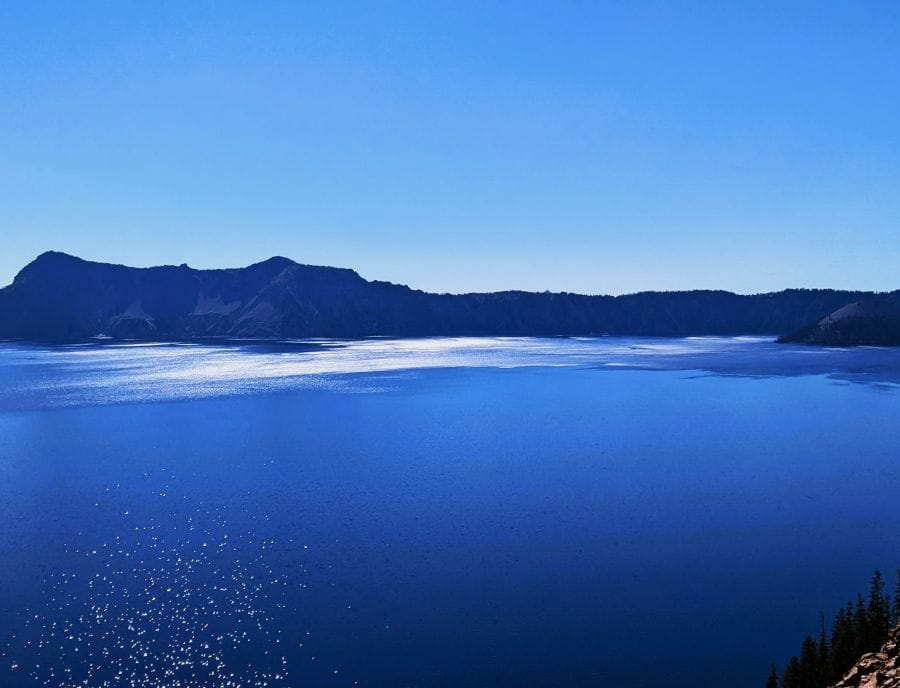
Some people visit Crater Lake during the winter. If you go in the winter, don’t expect to drive to the rim or see the lake without lots of hiking. When we visited in 2018, the parking lots and walking paths had not yet melted. Both had ice, and snow was still on them.
We had to carefully walk on the drifts to see the lake at the overlook. Most of the parking was plowed with snow at the edge. Crater Lake gets lots of snow, and the snow accumulation is typically 41 feet deep. During the winter of 1932-33, the measured snow depth was 73 feet. The projected opening of Rim Drive in the 2025 season is late June or early July.
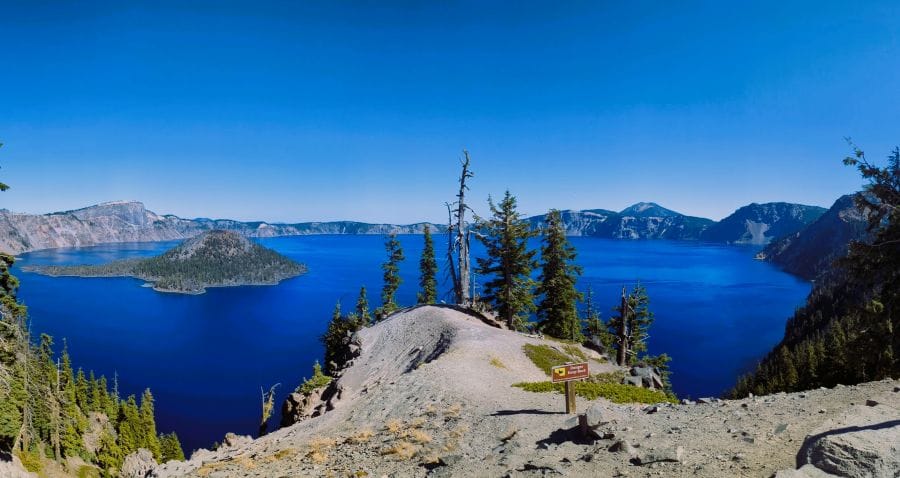
This article is an update of my 2018 article, which we visited again in the fall of 2024. During our 2024 visit, the campground and most of the main lodge were closed for winter. In 2018, due to the snow, we could only drive a short distance along the Rim Drive. Every year, usually well into the summer, the Rim Drive opens as the park service removes snow to allow traffic.
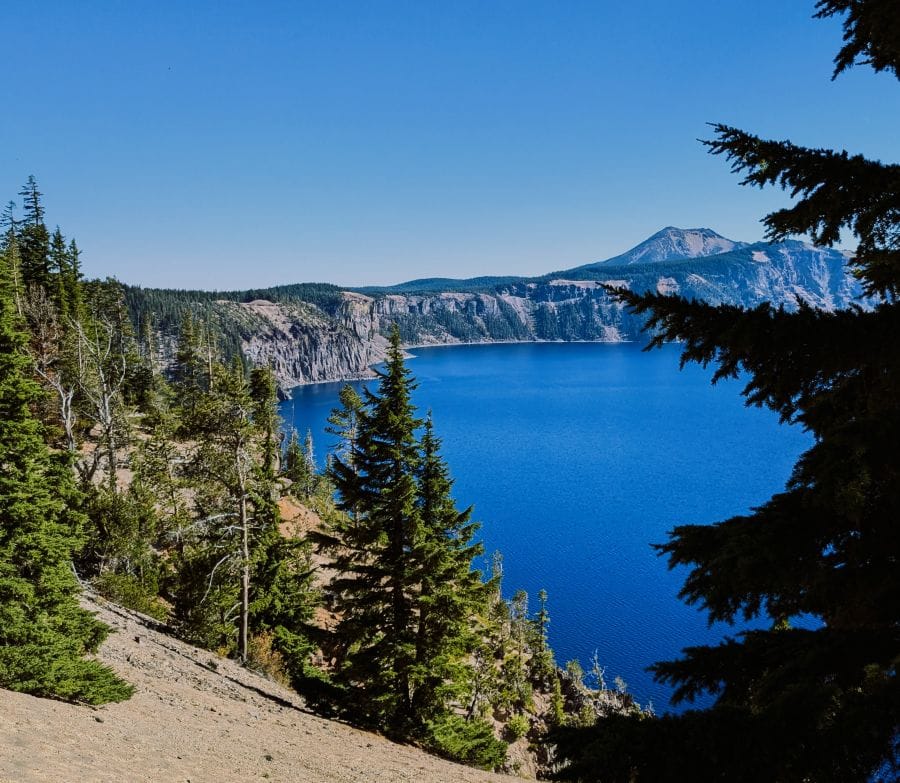
During our visit late in the fall last year, Rim Drive was cleared of snow but closed for construction nearly all summer. When we visited, the construction crews had packed up and left just before the winter snowfall. We were there just before the winter snowfall; most visitors were gone, and the road was open. Given our timing and the lack of visitors and vehicles late in the season, the Rim Drive was a prime target for a bike ride around the lake.
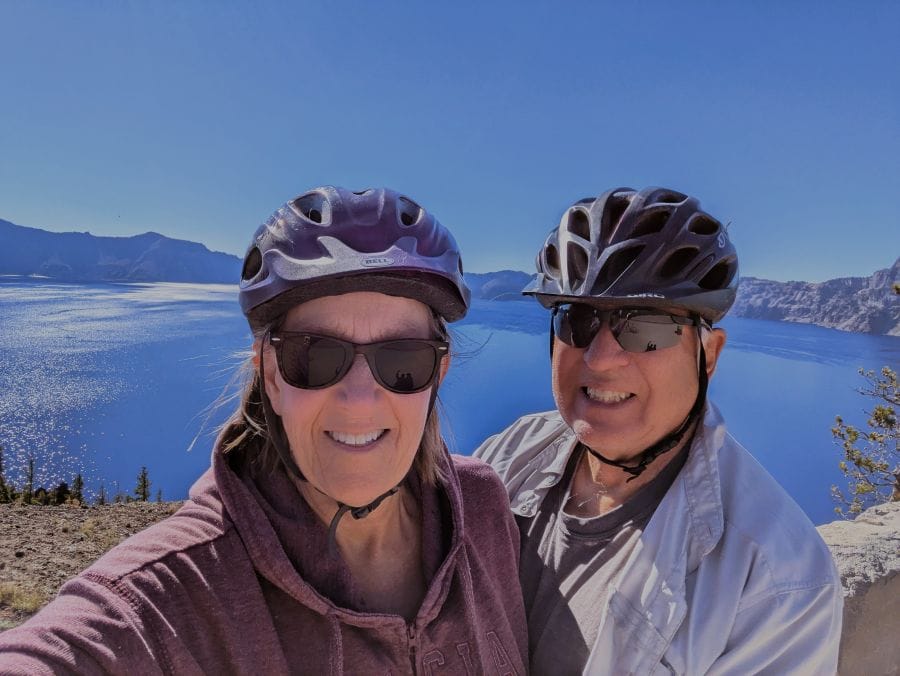
Crater Lake is at the top of a mountain.
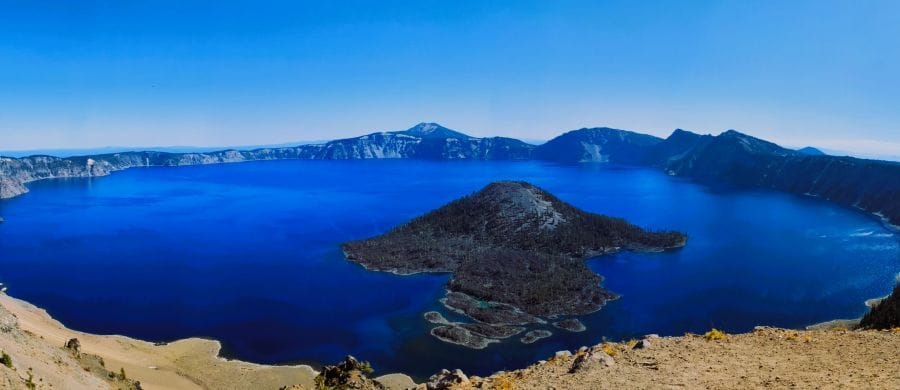
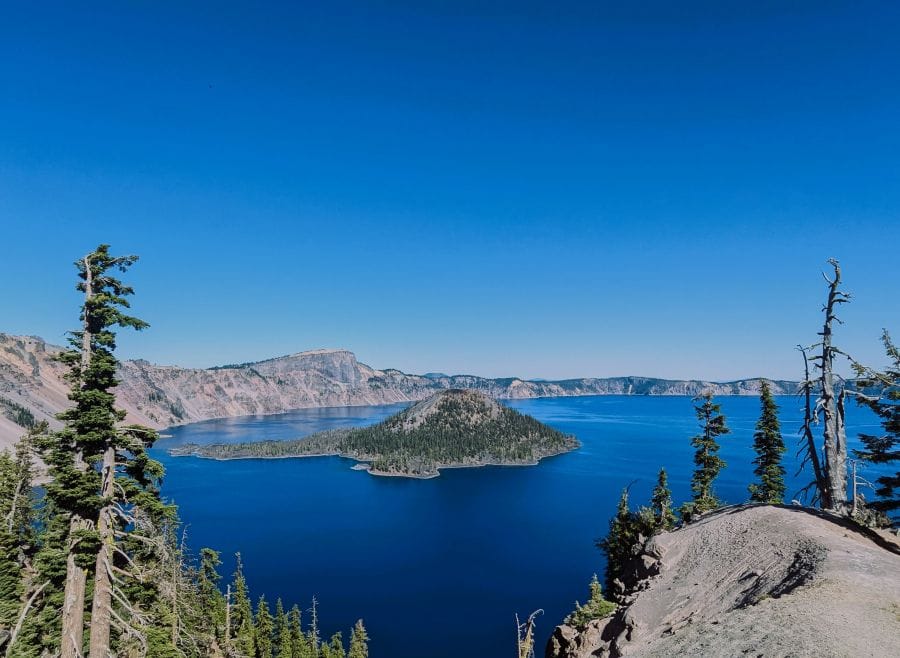
Crater Lake is at the top of Mount Mazama. I guess you can’t say it is really at the top because to form the caldera, which is now Crater Lake, the peak of Mount Mazama collapsed back into the lava dome. After the collapse, a new eruption formed Wizard Island. The rim around Crater Lake forms a dam. Only water that lands inside the rim (rain and snow melt) flows into the Crater Lake. It took perhaps a thousand years to fill the 2000-foot-deep caldera, creating Crater Lake.
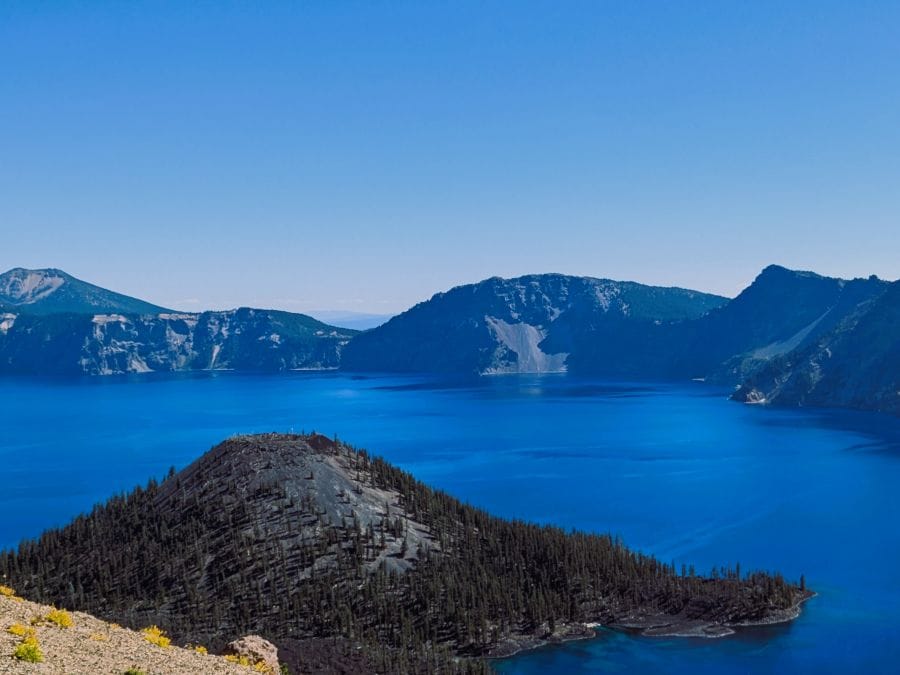
Wizard Island is a volcano inside a volcano. Both are the last remnants of Mount Mazama until the next eruption. Crater Lake is the deepest lake in the United States, nearly 2000 feet deep. We enjoyed both our 2018 and 2024 visits. Crater Lake is a photographer’s dream at any time, especially when there is snow.

Filling Crater Lake
Crater Lake National Park gets plenty of snow. Forty to fifty feet a year on average. All the water in the lake comes from rain or snow. The estimate is that the volume of water would take 250 years of precipitation to fill it – if there was zero evaporation. Evaporation means that it took much longer than 250 years to fill it. Thus, the water has been in this lake for a long time. There are no streams (above ground) exiting the lake.
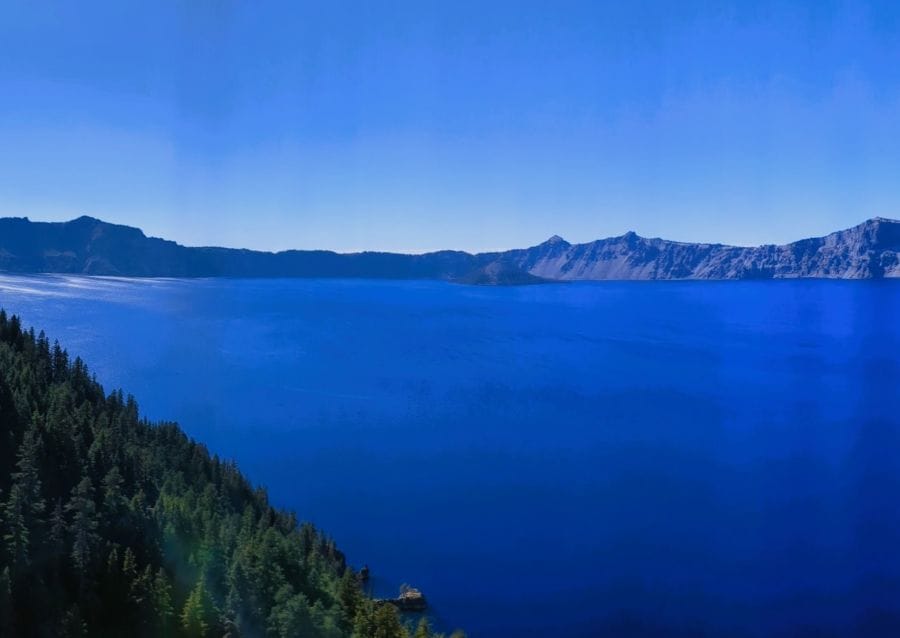
Over the last 50 years, the shoreline at Crater Lake has been remarkably stable. The water accumulation each year roughly equals the evaporation rate, and in the previous 100 years, the water depth has only varied by 16 feet.
Eruption
The last eruption of Mount Mazama is estimated to be 7,700 hundred years ago, and Mount Mazama is considered a dormant active volcano. In the previous eruption, the estimated violence was more than 40 times more powerful than the 1980 eruption of Mount St. Helens. The National Park Service theorizes that the next eruption will start underwater.
Water clarity
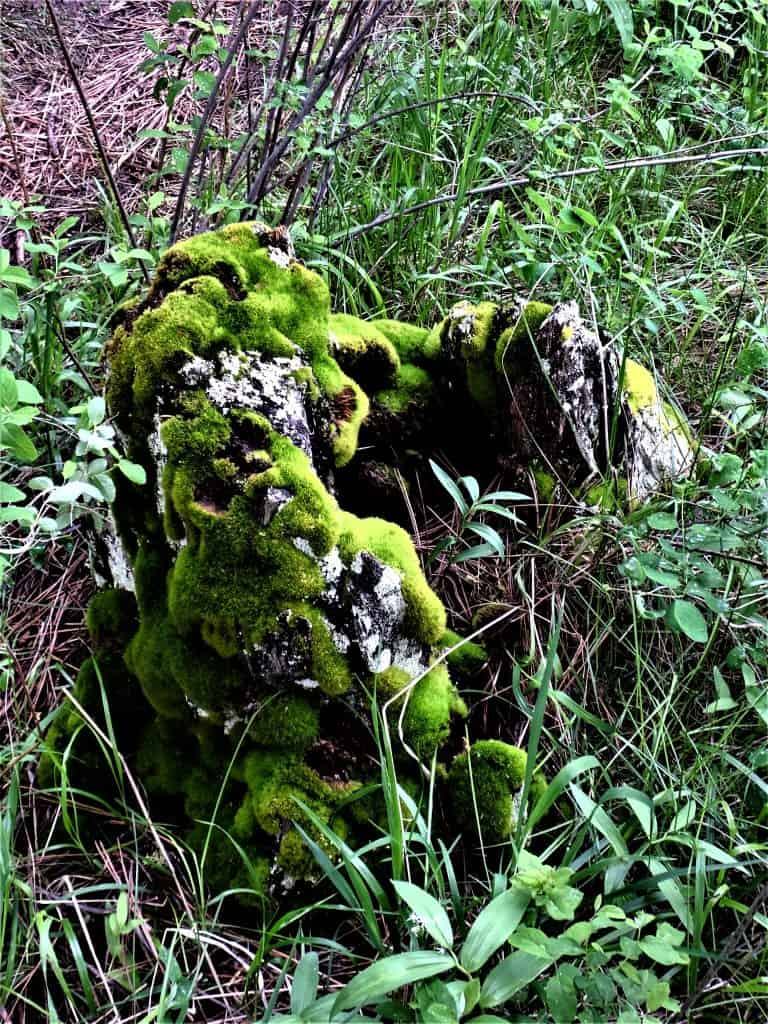
The water in Crater Lake is also amazingly clear. From one of my pictures, from miles away, looking at Wizard Island, you can easily see the bottom and rocks lying on the bottom. The picture was taken with a zoom lens, and further zoom was enhanced by cropping the photo. Scientists have measured underwater visibility, taken vertically at more than 175 feet. Water clarity has created environments for plant life that far exceed typical depths. Moss has been collected from depths of 600 feet. Plants can’t get enough light in most lakes for photosynthesis at more than 100 feet.

Partially closed due to snow for about 8 months of the year.
We didn’t stay at the campground at Crater Lake in 2018 because, in June, the campground was still closed due to the snowpack. When we arrived, only the road from the south was open, and the Rim Drive was still closed for most of its length. Instead, in 2018, we stayed at Crater Lake Resort, which was friendly enough but not nice enough to match the name “resort.” This commercial RV park is located south of Fort Klamath and north of Klamath Falls. The 30-mile drive to the park was pretty, so we made the trip multiple times. We even went to the park to catch the sunset and moonrise.

Boondocking
There is a boondocking site a few miles north of Fort Klamath that would have been acceptable in 2018, but we didn’t use it. The campsites in the National Park are available sometime in June (depending on snow depth), with reservations available only in July and August. I noted that the reservations seemed more pricy than those at other National Parks. Next time we are in the area (unless we visit in mid-summer), I intend to stay at Collier Memorial State Park.
Collier Memorial State Park
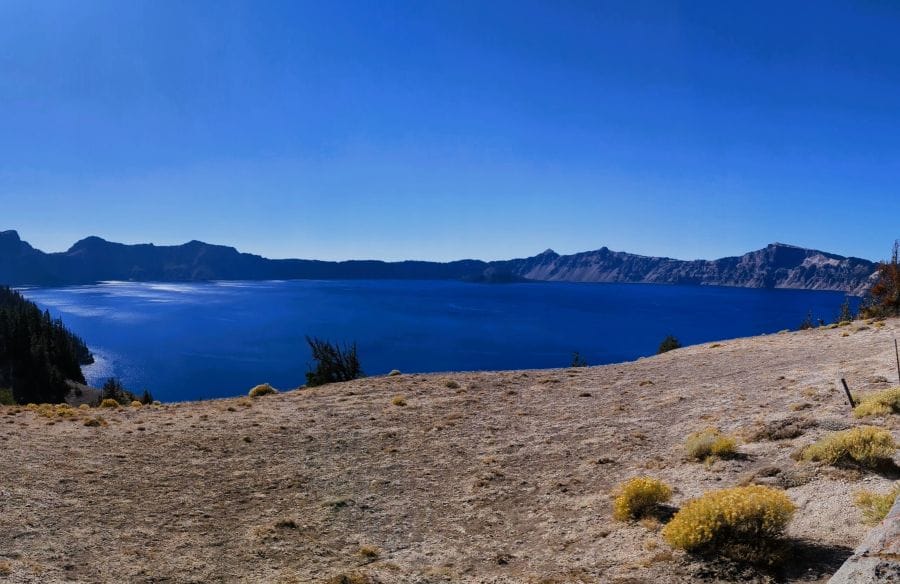
During our 2024 visit to Crater Lake, we could not stay at Collier Memorial State Park because it, too, was closed due to the expected arrival of winter. However, earlier in 2024, we were able to carve out a stay at Collier during the first part of June. We had a great time there, but too many other stories got in the way. I was saving the story to combine with our trip back to Crater Lake, but since it was already closed for the winter, that plan didn’t work. Collier Memorial State Park is still my recommended spot unless you are visiting Crater Lake in the middle of summer.

About that bike ride around the rim.
Without e-bikes, we wouldn’t have attempted riding bikes around Crater Lake on Rim Drive. Even with e-bikes, we didn’t ride the entire length of Rim Drive due to its 33-mile length. Since we didn’t make the whole loop, we took an out-and-back route, starting on the northwest side, riding to the southeast side, and returning. Our ride was long enough to take in the least traveled part of Rim Drive and short enough that our backsides were still happy and not too sore.
Rim drive is a constant series of steep hills and steep descents, which is why our e-bikes were crucial to our success. During the ride, we also learned a few things about riding e-bikes in the mountains. Unlike on flat terrain (e-bikes are faster but not necessary on flat terrain except during headwinds), we spent all our time climbing or descending. Our e-bikes are designed to make this possible. Without the motor assist, the climbing parts would have been a very slow process, even with the best gearing.
During the descent, we coasted with almost too much speed. At the next climb, we shifted into our climbing gear (the slowest and easiest gear) and engaged the electric motor. Our e-bikes are controlled based on torque (as opposed to pedal movement). Each power stroke of our pedals results in a surge in speed based on the combined effort of our pedal stroke and motor.
Between each power stroke (when the pedals were at the top or bottom of each revolution), our speed quickly decreased due to the steep hills we were climbing. This resulted in a very inconsistent speed. It didn’t take long to remember why I installed a throttle. Once we mashed the throttle (bypassing the torque sensor) to the maximum, the speed was much more steady (although still slow), making climbing the hills at Crater Lake much more enjoyable.
Please subscribe and join us on our journey.
We will add you to our email list and send you updates once a week. Here is a link. Subscribe
About our links
As you know, our blog income is zero, which allows us to be independent and tell the truth. We do not get income or commissions. No, we don’t make paid endorsements. We don’t make recommendations; instead, we will tell you what we like (or dislike). The links are only provided as a quick reference to help our readers.
Links
About Comments
We love seeing your comments, but they are not automatic. I get about twenty spam comments every day, and thus, I have to turn off automatic comments. I read and then publish every comment personally to protect the blog and keep it on the subject and real. So this means that you will not see your comment right after you hit submit. Sorry for the delay in publishing your comments. Please know that we would love to hear from you.
Wow, very pretty!
That is a picture postcard if I’ve ever seen one.
Gorgeous. Beautiful.
to Dave: Good view, could not take a bad picture. This place is pretty in every direction.
Scott, are there activities on Crater Lake like boating?
I can only imagine and I’m glad that you got to see it up close. So awesome.
to Dave: In the summer, after the snow clears, there is a trail that leads to the water. 700′ vertical descent. Boat rides, bank fishing. All the boats were lowered in on a cable or helicopter. Really it is mostly for looking at.
Gotcha
Wow. Beautiful!
Fantastic information.
I loved seeing these pictures. We were there in 2020. No snow. We didn’t get to go around the rim. But being around was scary enough with 3 kids with us. Thanks for sharing.
I have driven that highway in the winter and the snow was so deep next to the road.
I love reading about your travels! Gives me RV travel planning ideas for our adventures. Keep blogging!
Wishing you safe and fun travels,
Great write-up. We base about an hour from Crater Lake, and I’d only add that Collier wouldn’t be our choice to overnight unless you absolutely needed power. Farewell Bend on the Rogue River, Broken Arrow, or, if you aren’t too large, Diamond Lake Campground are great choices. The latter two are also closer to the park. The last time I checked (about 2 weeks ago), there were 120 inches of snow on the ground at the lodge. Keep the stories coming!
Still one of my all time favorite parks. Definitely worth a return trip (or 12). Your pictures are fabulous. And what a perfect way to enjoy all that beauty. Thanks for taking us along!
Great pictures, as always! We visited Crater Lake this past summer and stayed inside the park. Unfortunately, our stay was marred by forest fire smoke and the resulting significant haze – I actually went back to wearing a mask because it was just too much for me. We’ll need a repeat visit, probably earlier in the year, to avoid that fire threat.